A woman in love ventures out of her cocoon to go out into the mundane world of “dead language.” Two universes meet in raw, intimate drawings, shimmering stones and overpainted video sequences.
The truth is hidden behind blurs, but the allure of secrecy fades as the clarity increases. A woman in love ventures out of her cocoon to go out into the mundane world of “dead language.” Accompanied by a restless musical motif by Marian Mentrup, “Achill” boldly balances on the thin line between two universes – with raw, intimate drawings, shimmering stones and overpainted video sequences.

Among the Palms the Bomb, Or: Looking for Reflections in the Toxic Field of Plenty
Lukas Marxt, Vanja Smiljanić
The Salton Sea, a former nuclear testing ground on the brink of ecological collapse. The few people who still live here are campaigning to protect the abandoned area.
Among the Palms the Bomb, Or: Looking for Reflections in the Toxic Field of Plenty
Lukas Marxt, Vanja Smiljanić
Camera Lucida 2024
Documentary Film
Austria,
Germany
2024
86 minutes
English
Subtitles: 
English
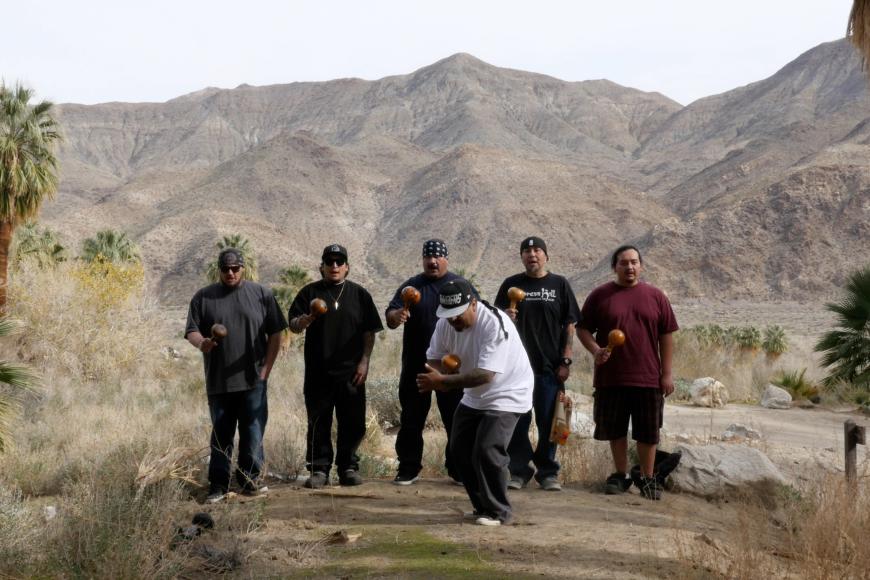
Where the sandy beach of the Salton Sea, the biggest lake in California, begins to crunch harder, it does not even consist of sand any more: Millions of dead fish, plants and insects pile up on the shore to form a highly toxic substance. This is how Derek explains it, a member of a Cahuilla tribe that managed to escape an attempted genocide in the 19th century to the Salton Sea and now sees itself as a protective force for the once flourishing but increasingly deserted area and its outcasts. Derek is one of the many locals whose trails Lukas Marxt and Vanja Smiljanić calmly follow, gliding with them through the desolate landscapes. In the process, they pick up slivers of nuclear history time and again: During the Second World War, the area was a test site for the bombs that were dropped on Hiroshima and Nagasaki. The experiments continued through the Cold War; the armed forces are still training here. The film finds its starting point and end two states away: The nuclear devices were sent on their way from Wendover, Utah. The local Airfield Museum pays tribute to their development. Once, the camera performs an almost weightless dance around a model of the Hiroshima bomb “Little Boy” on display there, to the sounds of the indestructible World War classic “We’ll Meet Again.”
All creatures in Greenland are green, except Bluekid. In this partly animated handicraft world, Mwita Mataro reflects on experiences of racism in Austria with children and experts.
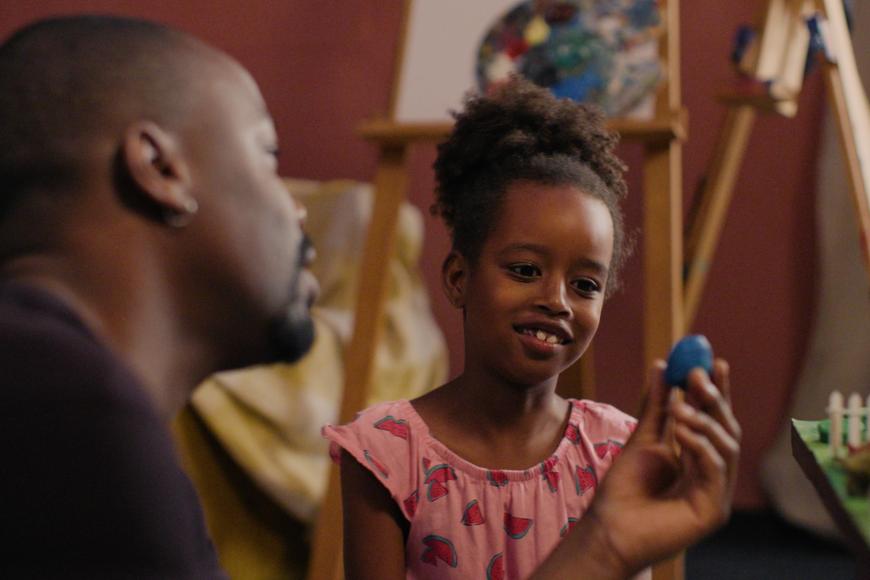
In his early twenties, Mwita Mataro set himself three big goals: become a rock star, make a film, and then found an art school in Tanzania. He has already accomplished the rock star part – he is the frontman of a band. And this film is his directorial debut. There was a choice of many subjects, something beautiful like friendship, for example. But there is one thing that bothers him more than his white film colleagues, and that is the colour of his skin. So what does it mean to grow up as a Salzburg native with Tanzanian roots, as a Black Person of Colour in predominantly white Austria? To investigate this, he has teamed up with young BPoCs to create the animated fantasy world Greenland: a place where all the potato creatures are green except Bluekid and his blue family. They paint themselves green to be less conspicuous, but since this does not always work out, Bluekid experiences rejection and marginalisation.
In his documentary essay, Mataro reflects on a daily reality based on colours: racism, alien attributions, otherness, blues experiences in Greenland. He listens to children and adults, lets the audience participate in talks with pedagogues, psychologists and politicians and opens up in front of the camera at home. With “Austroschwarz”, Mataro also comes one step closer to his third goal.
Tina Jany
Credits
Director
Mwita Mataro, Helmut Karner
Script
Mwita Mataro, Helmut Karner
Cinematographer
Jasmin Schwendinger
Editor
Christin Veith
Producer
Stephan Herzog, Andrea Elaiza Arnold
Sound
Cristi Iorga
Sound Design
Eli Frauscher
Score
Nicola Mpunga
Animation
Vladimir Savić
Nominated for:
Gedanken Aufschluss Prize,
Young Eyes Film Award,
Leipziger Ring
To animate means to bring to life, but that’s precisely what this architectural film does by means of a machine. What happens when an AI is entrusted with the creation of art?
Her “artificial assistant” is what Claudia Larcher calls the AI that digitally analysed her analogue “Baumeister” series of collages and generated this film from them. Creator or servant spirit, the machine makes architectural sketches waft biomorphically and enlivens (i.e. animates) rigid shapes. The Japanese Metabolists who called for the fluid renewal of their buildings, the organic growth, deformation and decay of architecture, would have liked “The Artist in the Machine”.