In 1940, two friends who grow up like brothers rescue horses destined for war in Sardinia. Only one of them will survive. An equally dark and poetic animation.
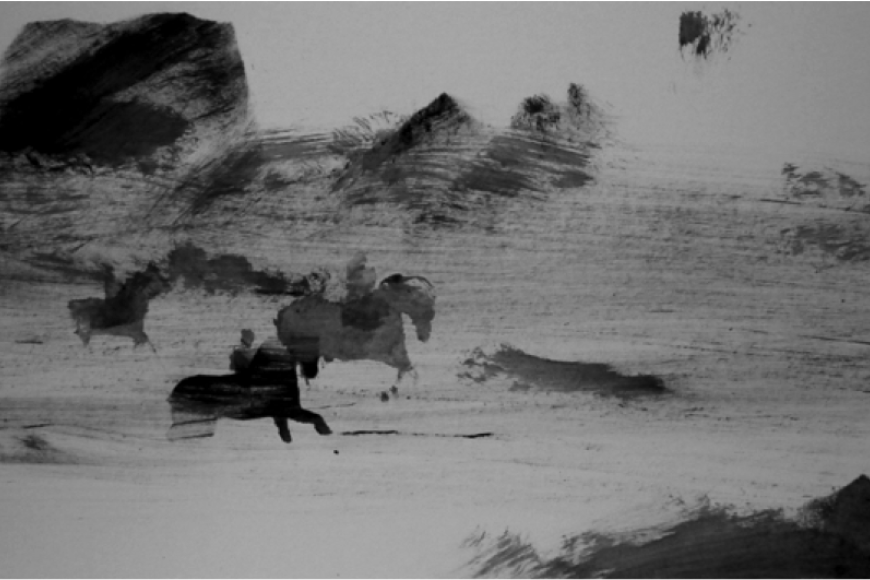
Sardinia, 1940. The harmless term “horsing around” takes on a very serious and ultimately tragic meaning for 14-year-old Michele and his 11-year-old friend Ventura. When they learn that the peasants have sold their best horses for serious money to the state and thus to the military for the approaching war, the two boys take a decision that is as naïve as it is intuitive: They free the herd in a daring nighttime operation. Their happiness is short-lived. Betrayed by a villager, they are caught on the way home and Ventura is shot dead. A senseless death? Or a sign of special bravery, as the ambiguous Sardinian film title suggests? Director Giovanni Columbu, a Sardinian himself, has dedicated his late animation debut to his grandmother who once told him the story. He took the liberty of adapting it with brushstrokes on paper, his style drawing primarily on the charms of historical painting schools, animation techniques and cinema genres. Columbu’s associative visual language, marked by shades of black, white, and grey, is animated by impulsive hatchings, countless dots, and generous elisions. The soundtrack, too, sets rather sparse nuances – subtle illustrations that draw on Sardinian cultural traditions while opening a space for universal metaphors.
Andreas Körner
Credits
Director
Giovanni Columbu
Script
Giovanni Columbu
Editor
Giovanni Columbu
Producer
Giovanni Columbu
Co-Producer
Flavia Oertwig
Score
André Feldhaus, Filippo Ripamonti, Alessandro Olla, Hans Zeller, Pietro Mascagni
A father disappears, literally flying away. What to do when a parent suffers from mental illness? A tender father-daughter reconciliation in poetic images.
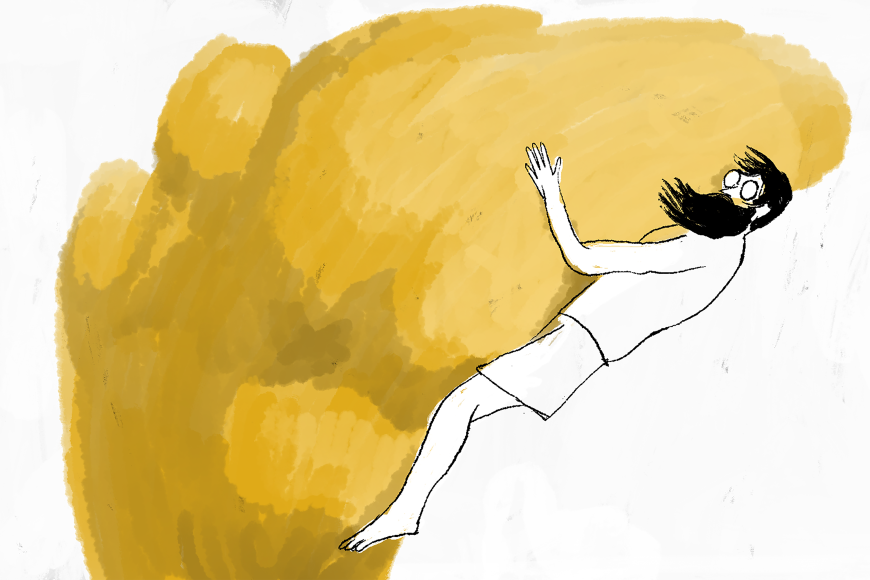
When the woman in curlers opens the door, Papa is blown away: Like a breath of air, a storm or tornado, he is blown in and back out. Even in his own apartment he is ungraspable: He grows and shrinks, becomes fragile or threatening, knocks everything down. And then he literally flies away, hurling eggs at passers-by. Caught in all this is his daughter, who at first can only helplessly stand by and who finds it increasingly difficult to visit him – the steps grow higher, the floor turns into chewing gum. Finally, she looks up at the sky and sees him hover there. What to do when one’s father suffers from mental illness? How to deal with it when the responsibility (of care) switches sides so early in life? Jelena Milunović explores this, using bold, very tender and not always obvious parables. She sets strong colour accents: The depressed episodes are in claustrophobic black and white, the ecstatic highs are colourful free-hand drawings. And the red balloon, which briefly appears in the beginning as a metaphorical vehicle of hope, might point the way to bringing the two of them back together.
Marie Ketzscher
Credits
Director
Jelena Milunović
Script
Jelena Milunović
Producer
Miloš Ivanović
Co-Producer
Draško Ivezić, Jelena Milunović, Filmuniversität Babelsberg KONRAD WOLF
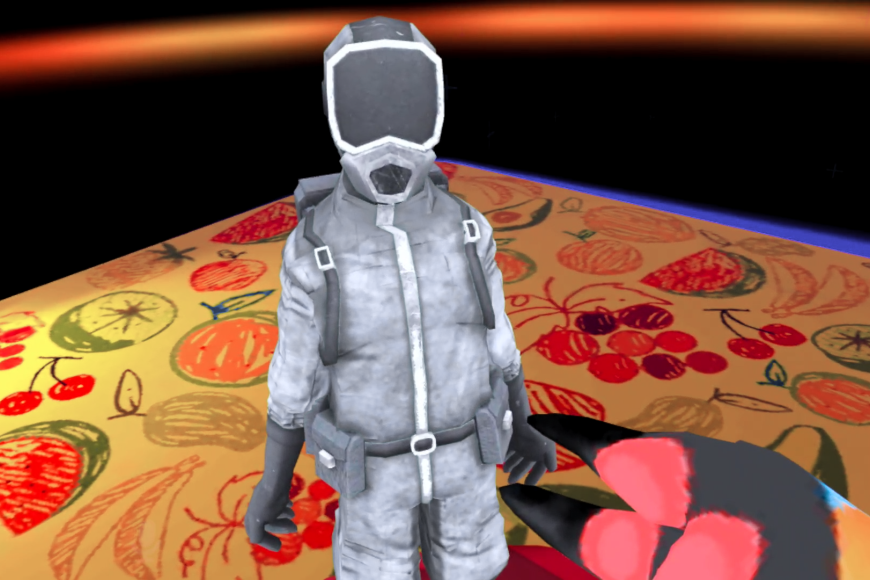
Is living as a mythical creature, mouse or furry not the most radical form of self-realization? In her film, Masłoń moves through VR spaces as an avatar to explore touch.
Is it not unlimited freedom, the most radical form of self-realisation, to exist in every conceivable setting as a flying mythical creature, a sad mouse or a furry figure with an extended naked spine as a tail? In her film, Monika Masłoń moves through different spaces as an avatar, exploring the subject of touching and being touched on VR platforms. Anything our phantasy can imagine can be created from pixels here. The limits of existence can be extended infinitely by a click. But what about human – or avatarian – closeness? Can an emotional signal like shaking hands be simulated in this VR world, despite the complete absence of physical bodies? When I see my avatar being touched, can my body memory suggest that I feel this tactile event even though there is no other physical body? Masłoń examines these questions with a delicate sense of humour and in exchanges with other avatars. But then we enter a VR space that feels more intimate: She has taken us on a personal date. How does the impossibility of physical touch in a long-distance relationship differ from that in VR? Can a VR date create more physical presence and still the longing for the beloved person better than other forms of communication?
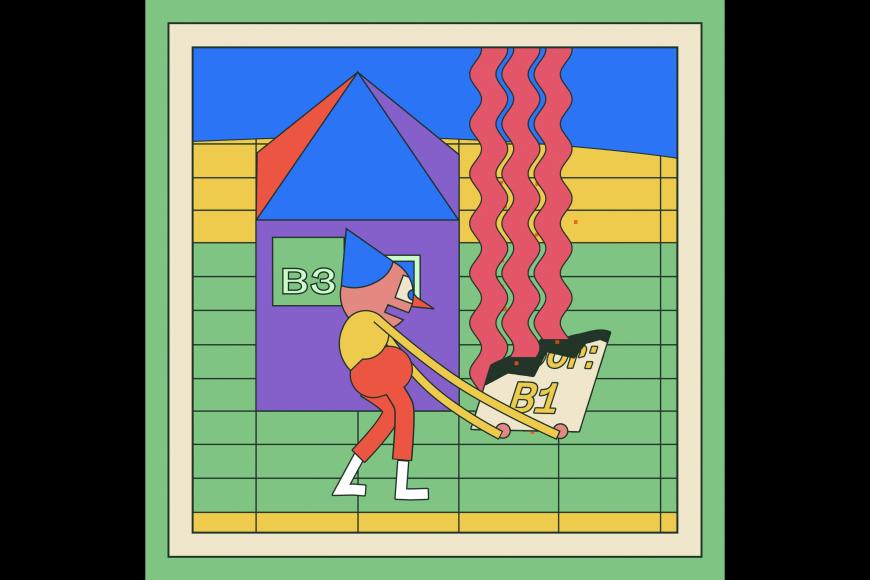
Can a calculated vector line inspire the same feelings as a drawn pixel line? A tongue-in-cheek declaration of love to the technology and aesthetics of the past 60 years.
This film grows somewhere between “forever” and “no longer”, between infinity and constraint, between absoluteness and concreteness. Everything is set in a square format, the original or pixel shape. But this square seems to be like a mirror facing another mirror, a self-referential optical illusion of infinity – with more than a grain of salt. We experience the humorous negotiation of an eternal issue of dispute among visual artists: Can a mathematically calculated vector line, scalable ad infinitum, inspire the same feelings in the beholder as a finite, imperfectly drawn line of pixels? Is the former not the visual equivalent of the neo-liberal illusion of infinite growth – shiny, but sickening? Could the mysterious pixelated moth resolve this eternal dispute? It guards the “Vectorial Superlooper” to ensure that this marvellous invention does not fall into the wrong hands. Jon Frickey spans an arc from our absurd, finite existence to the technological inventions that shape our sense of style, our taste, and thus our life. His film is a tongue-in-cheek declaration of love to the technology and aesthetics of the past 60 years: to pixel art, video games, television series, vector monitors – and, of course, to pixels and vectors themselves.
Film sketches compete for the filmmaker’s attention, scenarios push each other out of the way. Too much distraction, all the time. A feverishly associative animation about a neurodivergent mind.
Grandfather’s hands making pottery, the vertical linearity of a tower, a train crashing into a car – all of these are fragile, newly born film sketches that crowd each other out in a survival game for the filmmaker’s attention. The sceneries fight against each other, intertwine to form new strands, sink into an endless flood of information, shatter in a sea of open browser tabs. With his authentic voice-over and a mesmerising collection of moving images, director Konstantin von Sichart’s alter ego offers us a deep insight into his creative process. Marked by his neurodivergence, he learns before our eyes to cope with his inability to concentrate on one thing – and to weave meaning from these strands, remain true to his film idea. But how can this ever result in a film? Toxically coloured images, naively drawn and finely crafted, AI-generated, filmed from a monitor, collaged, worked-on – a wealth of tools and aesthetic approaches translates the described mental overload into the language of design. The film thus becomes more than a self-reflection of modern filmmaking: It is the portrait of a new generation – caught between the compulsion to take everything in and have a position on everything and the urge to stand still or even run away.