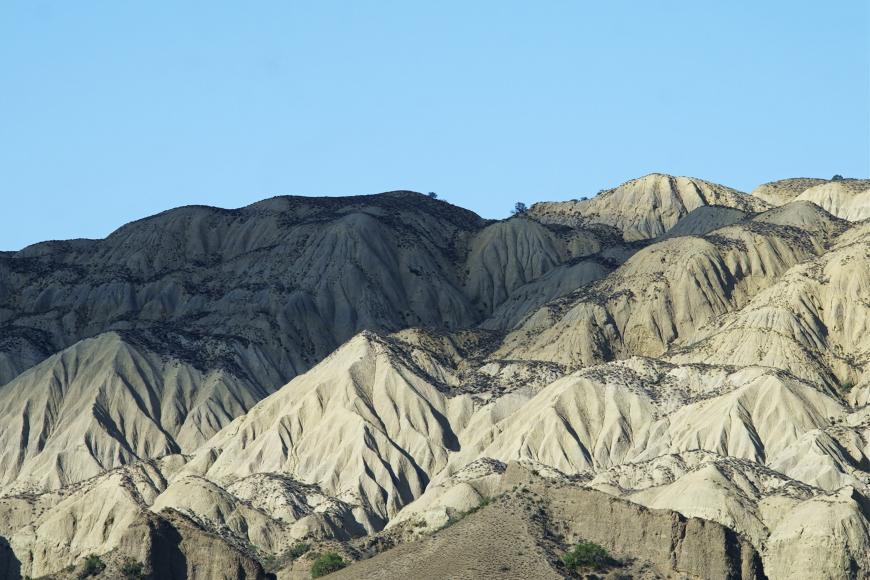
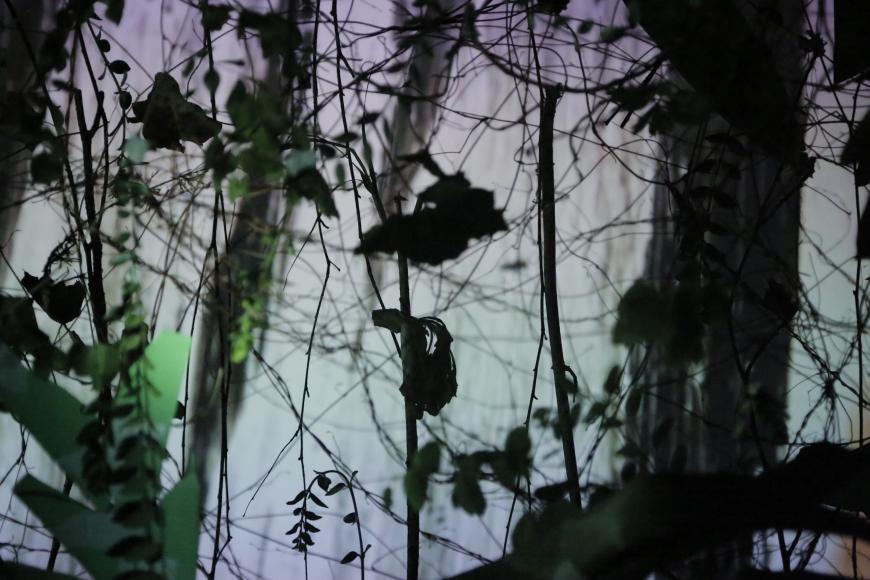
After the death of her grandparents, the director finds an expression for her grief in surreal rock and landscape formations. An associative, free-floating tour of inspection.
Surreal formations, stalactites, rocks moulded by water and poisonous bubbling. The images that turn into an exploration of her own soul for Paula Ďurinová seem like a dream landscape. Grief plays a key role – Ďurinová’s grandparents both died during the Covid pandemic. She looks for them between the gases and fumes, dives through a body of water that has ceased to exist but in whose cool freshness her grandfather once bathed his feet and across which she used to swim with her grandmother. “Lapilli” works in an associative and abstract way. At the same time, the minerals recovered by Ďurinová have something very concrete about them: compressed, buckled and broken, sharp-edged, corroded or gently polished. At one point, the director compares herself to a stone detached from its rock, questioning and without orientation, drifting around: “I don’t feel the ground anymore.” “Lapilli” leaves no doubt that feelings of pain and helplessness can harbour greater strength, but also a very special poetry and beauty. The interplay with an organic experimental soundscape opens up an intimate, almost universal experience.
The letters of former FARC guerrilleros from Colombia supply the basis of these personal memories. – A touching film with an impressive joy of visual experimentation.
Former fighters of the Colombian FARC guerilla report in letters on their most formative experiences from their time in the armed underground. University students from three continents adapt these personal memories in a parallel collective process to develop a touching film whose visual joy of experimentation is impressive.
Franka Sachse
Credits
Director
collective
Producer
Kunsthochschule für Medien Köln, National Institute of Design, Universidad Nacional Autónoma de México, Universidad Nacional de Colombia en Bogotá, Pontificia Universidad Javeriana, China Central Academy of Fine Arts
Two colour surfaces battle, taking up more and more space in their contest to outdo each other, causing breathlessness. An abstract and yet physically tangible cinematic event – large and loud.
Breathing is vital and needs space. A small blue square appears out of nowhere, vibrating nervously and growing into a narrow line. Its red mirror image follows suit. Both take up more and more room in a contest to outdo the other, while a growing shortness of breath is wedged between them. Martin Schmidt pulls off an astonishing feat: He generates a physically tangible cinematic experience from abstraction. He choreographs smooth surfaces in the cold, technical logic of their skirmish and electronically deconstructs the sounds of gasping. As the battle is getting fiercer, things are visually and acoustically compressed and stretched, twisted and filtered, until a heavy monster of tension emerges. “Lines” is big and loud; it can be read metaphorically, but also understood only in terms of its aesthetic power.