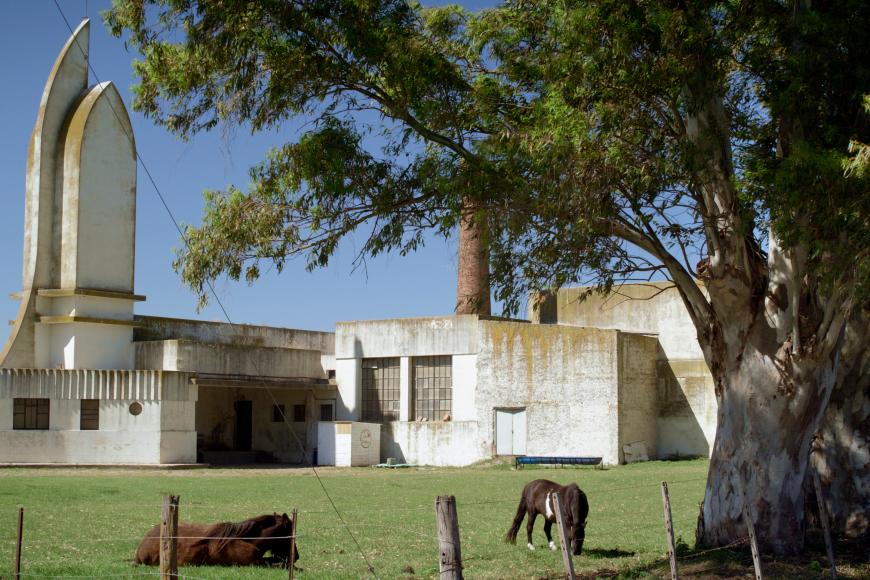
Slaughterhouses with concrete blades on top, monumental cemetery gates in the plains: Architect Francisco Salamone (1897–1959) shaped the image of the Argentinean pampa around Buenos Aires. In part 34 of his “Photography and beyond” series, Heinz Emigholz once more probes architecture for biographical traces. Salamone, who immigrated from Sicily as a child, realised his ideas between 1936 and 1940, when Mussolini’s Italy re-discovered architecture as an ideological craft.
Axes seem to be buried in the façade of the Coronel Pringles city hall. Elsewhere, stone tree fungi grow. And in front of the Saldungaray cemetery, viewed from the rear, a giant pancake or satellite dish forms, while in front the head of a suffering Jesus protrudes from the concrete. Monumental designs, occasionally incorporating elements of Art Deco or Italian Futurism, towering in the sky and advertising importance. Francisco Salamone worked in the years of the “Década infame”, that infamous decade followed shortly afterwards by the presidency of Juan Perón. The buildings seem inhospitable and full of hubris. They are supposed to herald modernity and progress and yet loomed terrifyingly over the peasantry of the country. Heinz Emigholz documents these intimidating buildings from every conceivable angle.
Carolin Weidner
Credits
Director
Heinz Emigholz
Script
Heinz Emigholz
Cinematographer
Heinz Emigholz, Till Beckmann
Editor
Till Beckmann, Heinz Emigholz
Producer
Irene von Alberti, Frieder Schlaich
Sound
Esteban Bellotto, Christian Obermaier, Jochen Jezussek
From the Argentinean pampa to the Bolivian highlands to the middle of Berlin: a trenchant critique of German history in its most visible manifestation, architecture.
An Argentinean builder who has built council halls, cemetery gates and abattoirs in the pampa as if from a modernist assembly line. Then a Bolivian architect, whose gaudy functional buildings in the highland defy description and imagination. Last, but not least, a new old palace in the middle of Berlin. Connections are plentiful, none of them edifying. Heinz Emigholz uses them for a pamphlet against stylistic amnesia and historical falsification.
The first film in Heinz Emigholz’s series “Photography and beyond” was released in 1983 and, including the two works screened by DOK Leipzig this year in the Camera Lucida section, there are now 35. But although “Slaughterhouses of Modernity” uses a number of sequences from the other two works, it has little in common with them in terms of form and ductus. While the aforementioned rather minimalist films do without commentary and partly without inserts, this one is characterised by its edgy monologues and courageous use of stylistic inconsistencies. Polemics and black humour are not unusual in Emigholz’s universe. But one has never seen him spoiling for a fight as gleefully as in this complex exploration of German history and its ugly manifestations. Not so much a late work as a new departure.
Christoph Terhechte
Credits
Director
Heinz Emigholz
Script
Heinz Emigholz
Cinematographer
Till Beckmann, Heinz Emigholz
Editor
Heinz Emigholz, Till Beckmann
Producer
Frieder Schlaich, Irene von Alberti
Co-Producer
Rolf Bergmann
Sound
Esteban Bellotto, Rainer Gerlach, Christian Obermaier, Jochen Jezussek
Score
Kiev Stingl
World Sales
Frieder Schlaich
Key Collaborator
Angel Cordero Siles
Narrator
Susanne Bredehöft, Heinz Emigholz, Kiev Stingl, Stefan Kolosko, Arno Brandlhuber
Nominated for:
VER.DI Prize for Solidarity, Humanity and Fairness
Ship ahoy, the musifants are afloat again! Charlie and Grandpa Günter get mail from the small green cactus in New Zealand. They set sail, singing their special shanty.
Ship ahoy, the musifants are back! This time, Charlie and Grandpa Günter get mail from the small green cactus in New Zealand and set sail with Fox and Captain Krause. On the way, they fish the little wild sow Svenja from the sea and sing their special shanty. The waves rise when the retired circus elephant makes musical forays into 1920s and 1930s song collections.
Father, mother, child – there are practically no exceptions to the ideal model family in the conservative part of Poland, and certainly no queer ones. Agnieszka hazards it anyway and takes the risk.
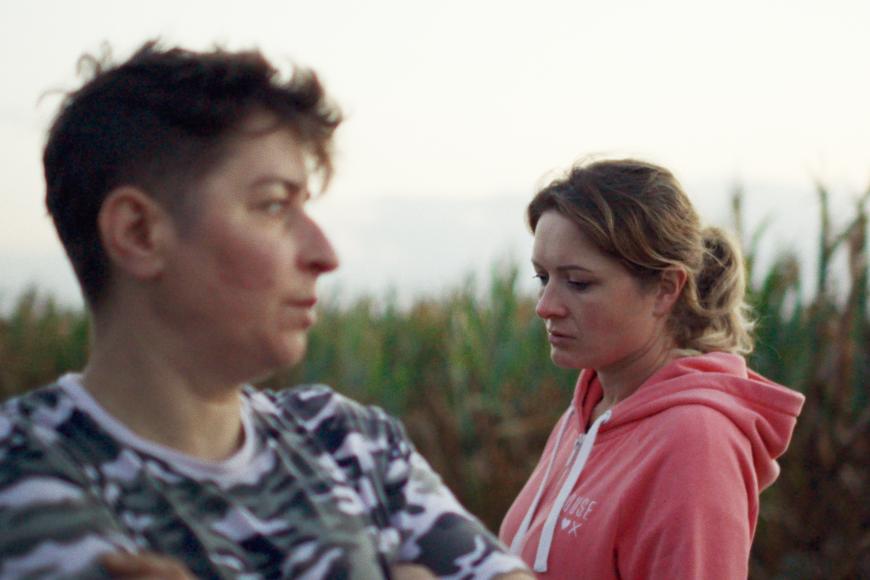
The rules in rural Poland are clear: Every man must have a woman; every dancer must have a female dancer. The pubescent Miłosz feels safe here, especially after his mother’s death. His sister Agnieszka, who is in a long-distance relationship with her friend Majka, does everything to obtain custody of her little brother. Gradually, a new family model is revealed, documented by Marek Kozakiewicz as an attempt that is as restrained as it is determined.
The windmills behind the houses rotate steadily, standing in place, signalling stability. But the lives of Miłosz and his 35-year-old sister are in turmoil. They are facing a red-tape marathon to make Agnieska his legal guardian: Both have been orphans for a few months. Director Marek Kozakiewicz depicts the establishment of a new family no one expects much applause for in conservative Poland. Because for Agnieszka and her partner, who is ten years older, the determination to try living together manifests tentatively. Without kisses, without celebrations, the decision almost casually becomes reality – the women are exploring the boundary between platonic tenderness and enforced secrecy. And Miłosz, too, seems to realise only slowly what the relationship between Majka and Agnieszka really is.
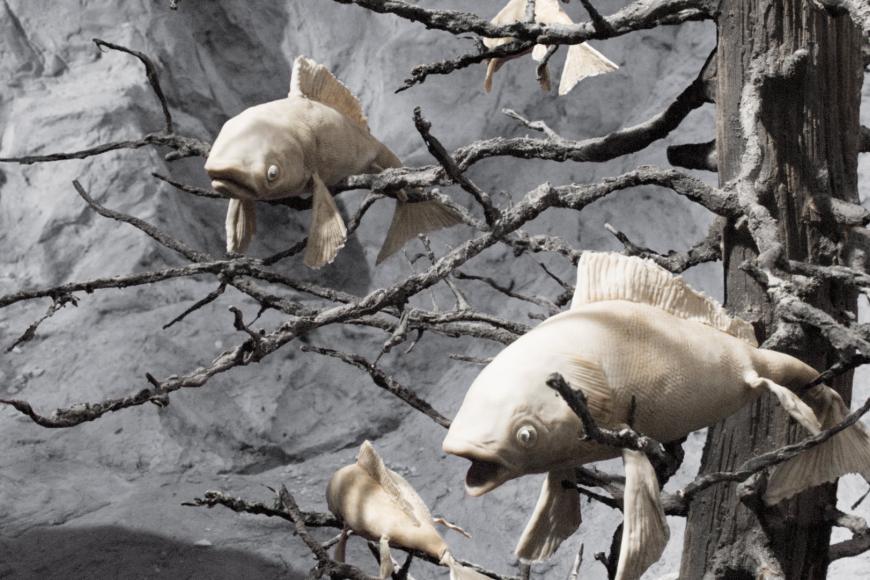
A demonstration set in an apocalyptic fantasy world with parable-like references to reality of how creatures (can) react when they are confronted with existential misery.
With his multiple award-winning animation, Jonatan Schwenk has created a haunting parable about compassion and solidarity. Mute creatures with burning eyes suddenly find themselves confronted with the distress of another species. At first their reaction is hesitant and stoic. But when the other species’ misery begins to disturb their peace of mind, they take action … “Sog” captivates with many creative ideas on the level of animation, succeeding in creating archaic images that look both abstract and realistic. Without a single word, the film makes us experience what a lack of empathy can lead to and that there are always at least two options for action.
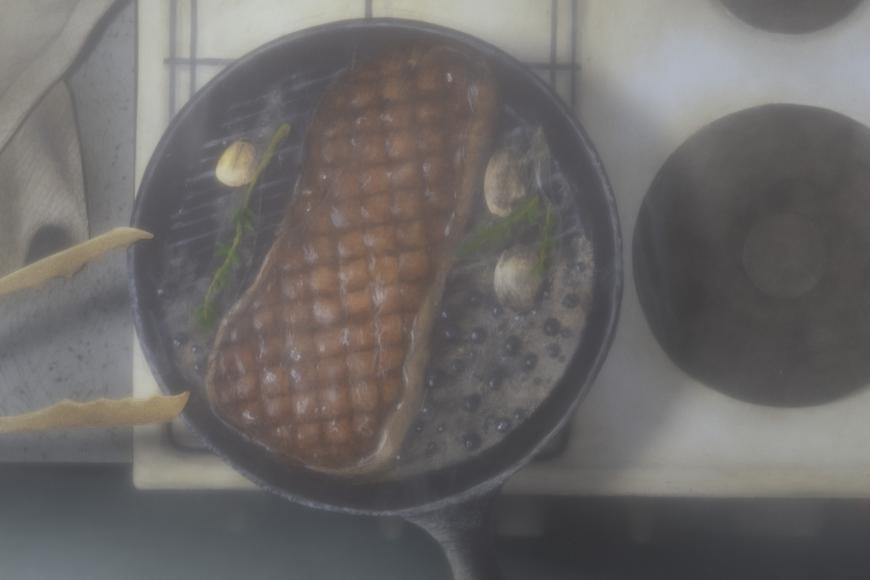
He and she are a good team. What was intended as a pleasant evening for two becomes overshadowed by an acrid cloud of roast fumes and ends civilized, but bloody: black humour, “well done”.
Coupledom has its own dynamics. Her professional obligations do not tick by the clock, his cooking and love are extraordinary, but, alas, precisely timed. This all too familiar incompatibility is condensed into murky, acrid roast fumes. What was intended as a pleasant evening for two ends civilized, but bloody: black humour, “well done”.
André Eckardt
Credits
Director
Špela Čadež
Script
Gregor Zorc
Cinematographer
Špela Čadež
Editor
Iva Kraljević
Producer
Tina Smrekar, Špela Čadež
Co-Producer
Emmanuel-Alain Raynal, Pierre Baussaron, Fabian Driehorst
Agnes travels from luxury kitchen to luxury kitchen. We follow the young woman on a culinary journey that lets us experience the craft of cooking from up close.
We’re travelling from luxury kitchen to luxury kitchen with Agnes, from Bergisch Gladbach via Barcelona to the Faroe Islands. The cook’s luggage always includes her backpack containing various knives, cleavers and tweezers. The camera watches over the inquisitive young woman’s shoulder as delicacies are being prepared. Our mouths water. At the same time, we get insights into the different ways of running a restaurant. It’s about team spirit and equality at the stove.
Goethe’s “Wilhelm Meister’s Apprenticeship and Travels” comes to mind, because this observational documentary is also like a novel of development. Agnes is ambitious, knows her craft. She wants to be her own boss one day. She soon finds her way around every new team, takes her place. It’s a sensuous pleasure to watch how the many hands interlock, how culinary creations are lovingly made, delicately plucked salad leaves arranged as decorations. At the same time, Agnes has to struggle against opposition. Her wages are low. A colleague asks her what business she, who has just finished her apprenticeship, has in a three-star restaurant. Agnes is moving in a male domain, in an environment that tends to pass the pressure down. But in the course of her journey, she also comes across collective forms of cooperation and new visions of cooking.
Anke Leweke
Credits
Director
Gereon Wetzel, Melanie Liebheit
Cinematographer
Gereon Wetzel
Editor
Stephan Bechinger
Producer
Florian Brüning, Thomas Herberth, Alireza Golafshan
Sound
Melanie Liebheit
Score
Wolf-Maximillian Liebich
World Sales
Georg Gruber
Funder
FilmFernsehFonds Bayern, Filmfonds Wien, ORF Film/Fernsehabkommen, Deutscher Filmförderfonds (DFFF), Österreichisches Filminstitut, BKM – Staatsministerin Kultur und Medien, Filmstandort Austria (FISA)
Nominated for:
VER.DI Prize for Solidarity, Humanity and Fairness,
Young Eyes Film Award,
DEFA Sponsoring Prize