A bicycle accident causes a crack in the protective shell Alice has grown to be able to bear the oppressive confinement of her daily life. Can she finally dance her way out?
It is Alice’s 27th birthday today. She lives in her old room in her parents’ apartment. Her mother coddles her like a little child. Her kid brother gets on her nerves. The only space for self-realisation and living out her sexual desires is in her imagination, if at all. For economic reasons, she and many other young people are denied the chance to live an independent life in their own four walls. So Alice has to endure the confinement.
On the night of her birthday, she goes pub-crawling with a buddy and dances, free at last for a few moments, at a party on the roof of a high-rise. Looking at the nocturnal city and sobering up after all the exuberance, though, her dilemma re-surfaces again: Where is her private space where body and soul can unfold unobserved? Haunting, colourful, with a fantastic soundtrack and full of eroticism, the film describes the depressing situation of a whole generation.
Franka Sachse
Credits
Director
Flóra Anna Buda
Script
Flóra Anna Buda
Editor
Albane du Plessix
Producer
Emmanuel-Alain Raynal, Pierre Baussaron, Gábor Osváth, Péter Benjámin Lukács
Sound
Péter Benjámin Lukács
Score
Mári Mákó, Rozi Mákó
Animation
Zoltán Koska, Gábor Mariai, Luca Tóth, Borbála Zétényi, Flóra Anna Buda
“It’s all over.” The worst possible fate for opponents of the regime, underlaid by a reference to “The Unkown Soldier” by The Doors. Radically simple and maximally impressive.
An execution illustrated from the point of view of the condemned man, with a musical reference to the song “The Unknown Soldier” by The Doors. Ferenc Rófusz’s film may not have been a direct statement about the roughly 200 death sentences issued against all manner of opponents of the regime in Hungary after the uprising, but its poignancy speaks for itself.
Loneliness and threat, translated into surreal images in which the oppressive Hungarian reality of life under communism in the 1980s allegorically meets the 1956 uprising.
A feeling of fear spreads: In an apartment building, the stairs follow no logic, men get lost with a wardrobe, everyone is lonely. The surreal threat suddenly becomes real when security agents ring the doorbell: “Csengőfrász”, the symbol for the arbitrary arrest of citizens allegedly hostile to the state from the time of the Hungarian Uprising.
Learning a foreign language is like creating another self. How can you speak it without losing your own sound, without dissolving completely in it – and still be heard and noticed? This film is a charming and intellectually fastidious attempt to navigate the complexities of language, identity and trauma.
To do this, the filmmaker resorts to her own biography. Because Russia invaded Ukraine when Daryna Mamaisur, who comes from Kyiv, was in Portugal for a Doc Nomads graduate course. Home and the search for it became the defining factors of this work, as well as the traumatic situation of only being able to “witness” the difficult situation from a distance. She, the Ukrainian in Portugal, learns Portuguese. She lets the new words for “war,” “explosion” and “attack” roll off her tongue. She compares them with the soft, intimate sound of her native language, with the sound of Kyiv. Friends send audio and visual recordings from Ukraine which, combined with animations, become a multilayered essay and finally a testimony – for the resilience of language and culture, no matter where they are spoken and lived, and not least for the power of the artistic documentary, which can make speech and sound possible.
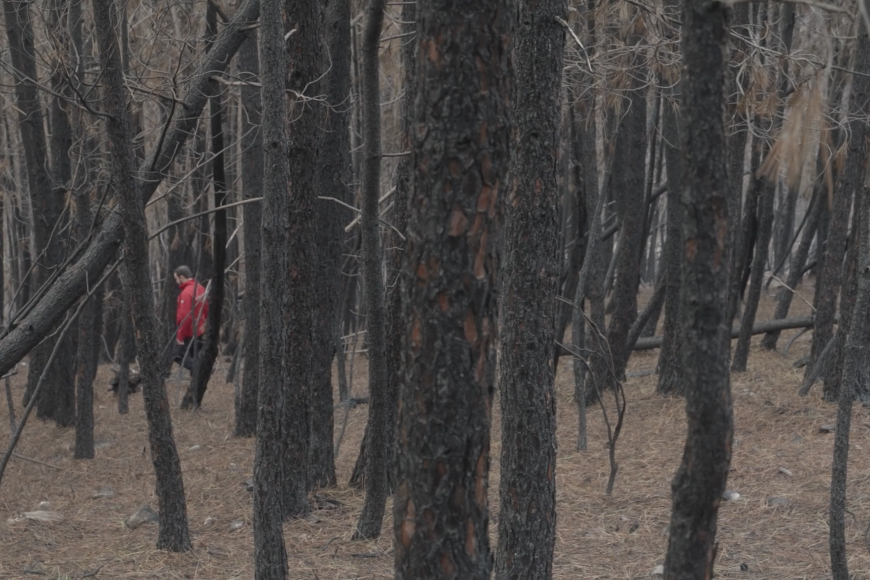
Cleaning up after a forest fire in the mountains of Portugal: New trees are planted, nature begins to sprout again. But will the fire devour everything one day?
“See you next year!” a Portuguese fire warden says as he dismantles his control equipment at the end of the season. Humans and nature in southern Europe may be used to forest fires, but that does not change the facts: The ever more massive conflagrations are caused by climate change. We have long been living in the age of fire.
In the Portuguese interior, a forest fire has just devastated a large area. Wounded nature is silent, not a single bird is heard, only the wind that makes the charred tree trunks rustle. But the vegetation recovers astonishingly fast. Where all life seemed to be gone, greenery soon sprouts from the ruined trees. The residents of the affected region are engaged in the reconstruction with great respect for their natural environment. Because plants, too, are sentient creatures. In quiet, almost melancholic, but also hopeful images, the film pays tribute to the strength of the trees and illustrates how essential it would be for humanity to learn to live in harmony with nature again.
Annina Wettstein
Credits
Director
Juliette Menthonnex
Cinematographer
Ilona Szekeres, Sergio da Costa
Editor
Antoine Flahaut, Juliette Menthonnex
Producer
Véronique Vergari, Victor Candeias, Agnès Boutruche