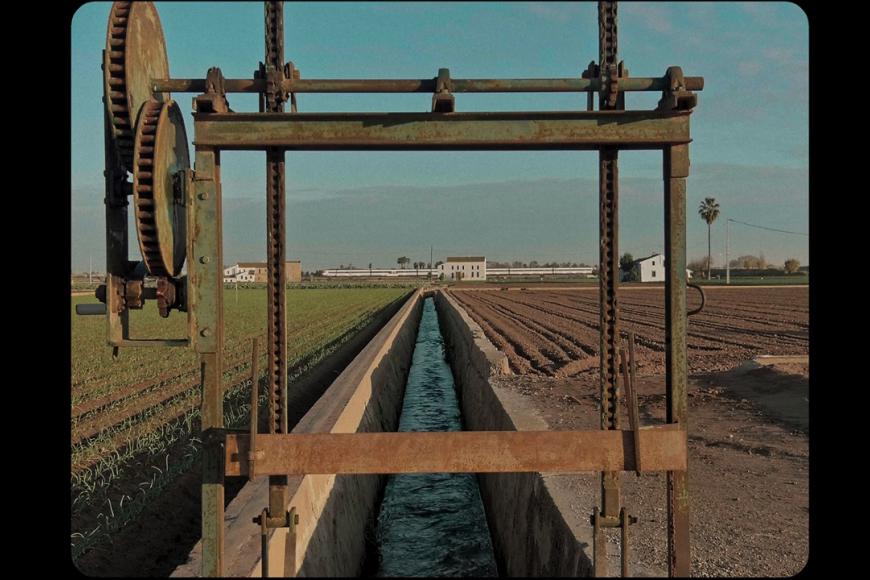
The Huerta Valenciana is a unique cultural landscape of fields and plantations. For generations this region, mainly planted with perennially rotating crops of tigernuts, artichokes and onions, was regarded as the vegetable garden of Spain. “Camagroga” is a filmic elegy about peasant pride and how it is inscribed in the physiognomies, gestures and postures of the people behind these agricultural products.
Tardor, as autumn is called in the Valencian regional language, is the season when the tigernut straw is burned on the fields to make the winter harvest of the nut-sized bulbs easier. Antonio Ramon and his daughter Inma run a farm of just under four hectares north of Valencia – hardly a profitable size nowadays. And yet they apply a surfeit of care and traditional knowledge to their products, seemingly following the impulses of their vegetative nerve system rather than a deliberate programme. Ever since their fields were also identified as prime real estate in the development plan of the expanding provincial capital, however, they have known that the battle zone has already reached their barn door.
Ralph Eue
Credits
Director
Alfonso Amador
Script
Alfonso Amador
Cinematographer
Alfonso Amador
Editor
Sergi Dies
Producer
Xavier Crespo, Alfonso Amador
Sound
Jorge Salvà, José Serrador
Score
Carles Dènia, Pep Gimeno, Miquel Gil
Nominated for:
Prize of the Interreligious Jury,
FIPRESCI Prize
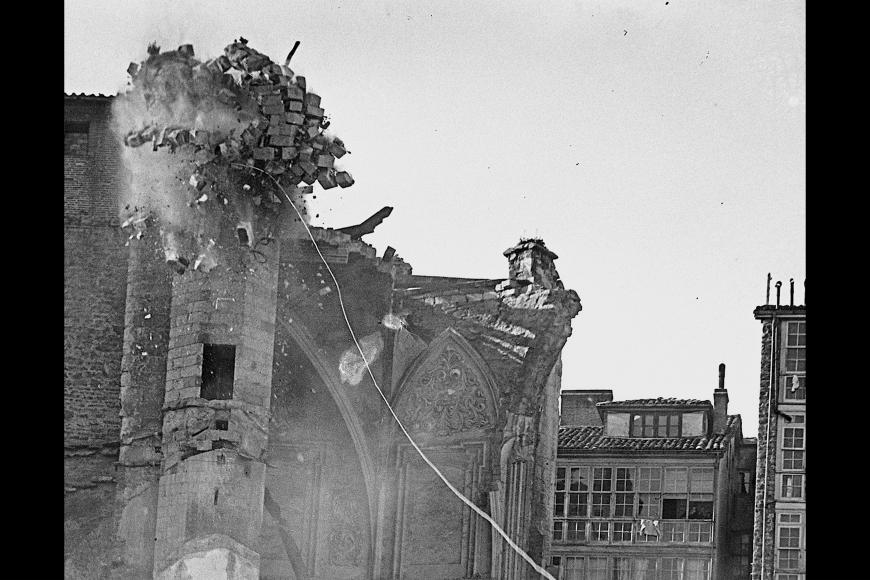
The six-decade transformation of a block of houses, shown by means of artfully featured archival shots, highlights the beauty and sadness of human-made decay.
In the blink of an eye – as the film is titled – 66 years pass by, seven centuries of stone crumble and a savings bank replaces a church. In six and two half chapters, Jorge Moneo Quintana succeeds in a feat of archival work, montage and sound design. The organic merging of images that show the site’s transformation submerge the audience into a pleasantly sober reflection on the beauty and sadness of decay.
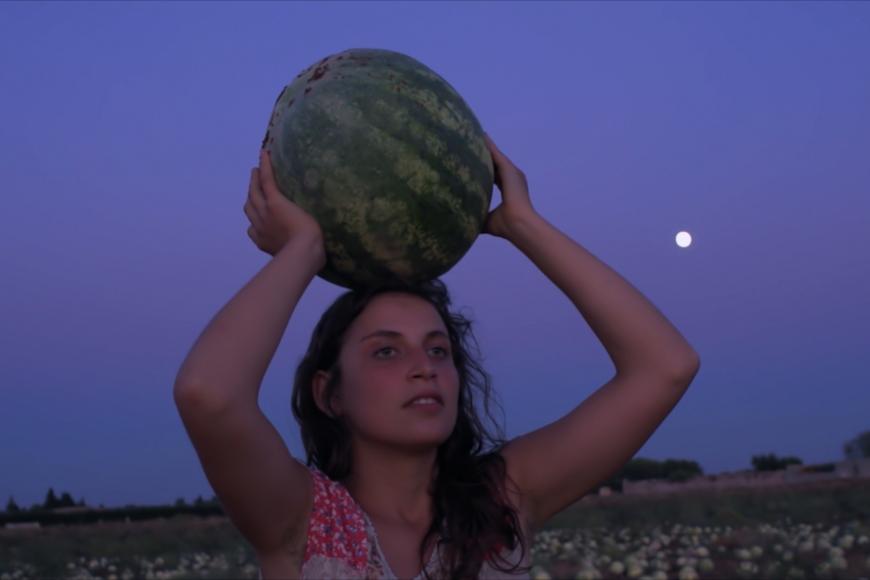
A portrait steeped in colours and music of a young singer quivering with life, her dedication to the traditions of southern Italy and her attempt to break out. Freedom. Rhythm. Tragedy.
Enza, in her early twenties, is a singer and seeker studying the rhythms of life in Salento. She breathes music, collects old folksongs and thus connects the people, the present and the past. Rooted in Tarantism and in the tradition of the healers she uses singing as a means to fight alienation. Her portrait is a cinematic legacy vibrating with intensity. It reveals the thin line walked by those who refuse to be satisfied with relative freedom.
A conventional sign that reads simply “park” triggers a storm of thoughts for a well-to-do older gentleman. With just one word, his cosy everyday routine is turned upside down.
Competition for the Audience Award Short Film 2020
Animated Film
Spain
2020
13 minutes
Spanish
Subtitles:
English
As a happily married manager of a department store, everything in the protagonist’s life is peaceful and orderly. But on his customary walk through the park one Sunday, he is suddenly confused by a sign marked with just one word: “Park”. The disturbance is so great that his everyday routine is thrown into chaos. Freely adapted from a story by Arthur Schnitzler.
The day begins for father and daughter. They climb beyond their treehouse, glide over and under water, cross blooming landscapes, travel through the air and fly on into space. By ship, bicycle, balloon or on foot. A film about travelling, collecting souvenirs in passing and the question of what’s left at the end of a life.
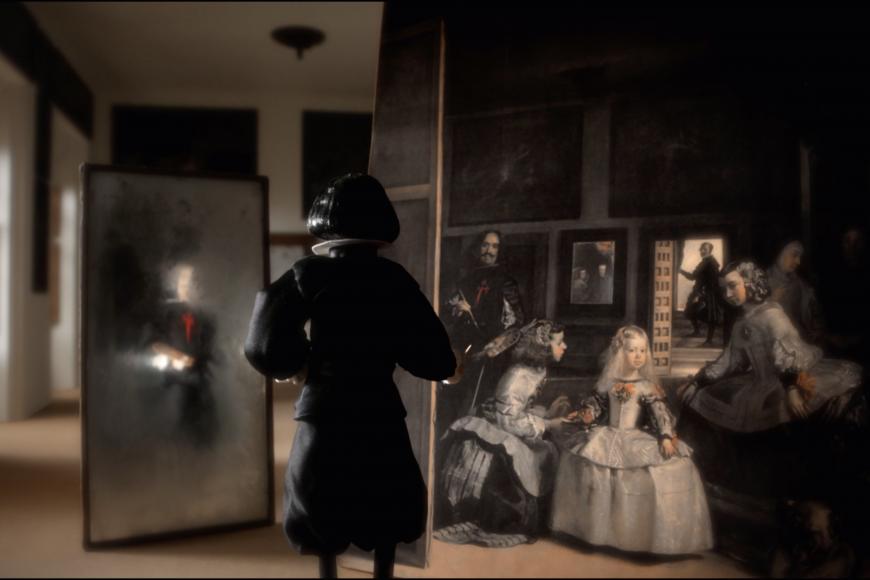
Are we looking at a painting or is it looking back at us? Velázquez’s larger-than-life painting “Las Meninas” sparks captivating digressions about curiosity and penetrating gazes.
It has been said that the baroque artist Diego Velázquez didn’t paint figures, but the air and light between them. And one could say about this film that it is not Velázquez’s larger-than-life painting “Las Meninas” that is the subject, but the penetrating gaze with which it looks back at his viewers. Among the many clever minds that discuss the artist and the intricate structure of this painting’s composition, it is curiosity itself that somnambulates here.
“Paintings aren’t movies, they’re paintings”, insists art critic and historian Svetlana Alpers. She’s right, of course – and then again, she isn’t. She’s one of the renowned talking heads interrogated by director Andrés Sanz Vicente to solve a crime. But who or what actually died? Perhaps our ability to see, as Alpers claims? For around 400 years, Diego Velázquez’ painting has been exposed to the eyes of its public, the analyses of its scientifically advanced critics who have racked their brains over who on the canvas enters through which door and why. “The Painting” is a continuation of this painting-eye-encounter with the means of cinema. The air and the light between the concrete thing and its passionately glowing aura are captured. In this, but only in this, a painting can be a movie after all.
The Smallest of Worlds – A Social Landscape of Collected Privacy
Uwe Brunner, Bettina Katja Lange, Joan Soler-Adillon
Walk-in archive, time capsule and storage for the collective memory of a state of emergency: globally collected snapshots of self-isolation and quarantine.
The Smallest of Worlds – A Social Landscape of Collected Privacy
The Smallest of Worlds – A Social Landscape of Collected Privacy
Uwe Brunner, Bettina Katja Lange, Joan Soler-Adillon
Extended Reality 2020
-
Austria,
Germany,
Spain
2020
10 minutes
English
Covid-19 has made quarantine and self-isolation the everyday experience for many. This project, developed at the CPH:LAB, invites people to scan their most personal places and moments. The resulting VR experience is a walk-in archive and time capsule, the collective memory of a state of emergency which also preserves forgotten virtues like deceleration and the spirit of discovery.
Lars Rummel
Credits
Director
Uwe Brunner, Bettina Katja Lange, Joan Soler-Adillon