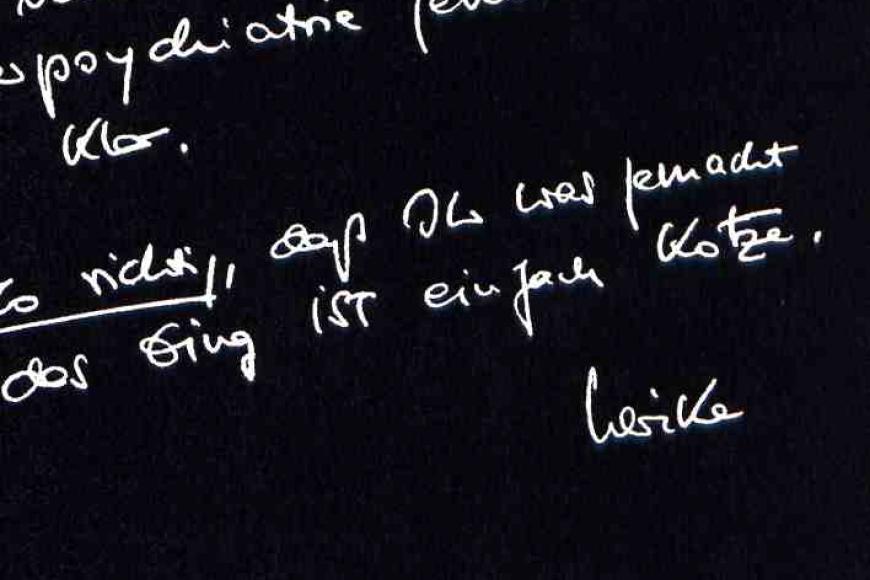
It could be called a portrait or a composition with text and sound. Ulrike Meinhof’s “Letter from a prisoner in the isolation wing”, written in prison in 1972/73, a document of detention in thought cascades, lends structure and weight to fifteen minutes of film. The apparently black background is dimly animated at intervals, hinting at a nocturnal outside or an area near water. This attempt to communicate the sensory deprivation resulting from isolation attempts what’s actually impossible, pushing towards abstraction, harsh, brutal, dry. Any narrative “grease” is discarded. There is no space at all, hence not for a narrative, either.
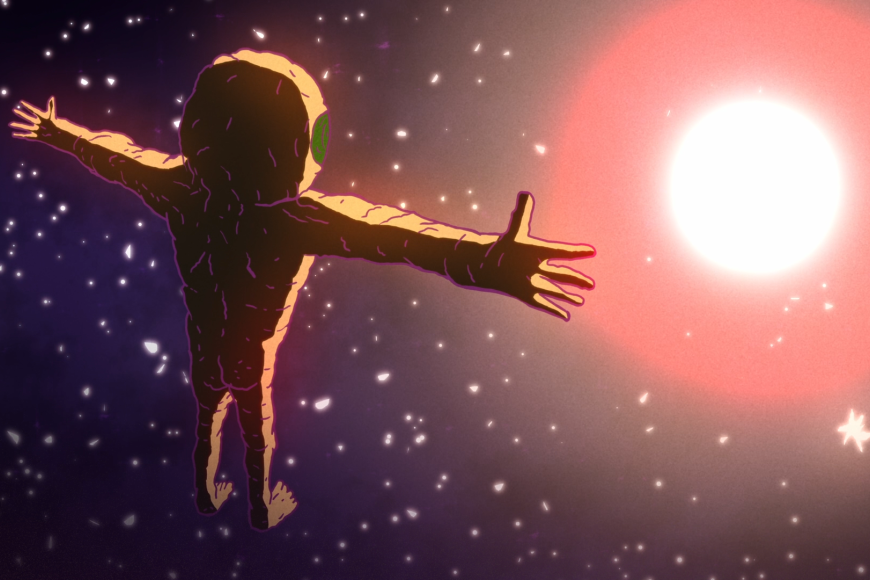
Frankie feels terminally ill, but nobody cares. Then his body transforms into a wild planet where evolution fast forwards from creation to destruction.
Contemplating your naked body, drenched in tomato sauce, on a frozen pizza – that is the epitome of alienated wage work. Especially if it is the mass product whose quality has to be checked hundreds of times a day at the assembly line. Is it this alienation, the multiple daily consumption of precisely this meal or simply the absence of significant human relationships that make Frankie feel terminally ill and ready to say goodbye to an existence he feels is worthless and empty? Nobody cares, until his body transforms into a wild planet where evolution happens in fast-forward mode: the genesis of life, miniature Frankies performing absurd penis dances, cannibalism, Darwinism, mutual destruction, the eradication of other species – and finally the Frankie planet itself burning out. Levi Stoops makes us laugh out loud – and yet we feel the bitter taste of self-destruction on our tongue. Will Frankie have the courage to risk a change of life after this apocalyptic experience? Or does the system have him so firmly in its claws that wholesome nature documentaries of exotic flowers are comfort enough – instead of cooking shows where the stone-baked pizzas are tossed into the air with verve?
Irina Rubina
Credits
Director
Levi Stoops
Script
Levi Stoops
Editor
Levi Stoops
Producer
Annemie Degryse
Sound
Paulo Rietjens
Sound Design
Paulo Rietjens
Score
Wiet Lengeler
Animation
Camiel Hermans, Sarah Menheere, Karolien Raeymaekers, Neyrouz Jemour, Jana Leeuwerck
Shepherdess Nathalie learns what it means to kill with one’s own hands. Her process of development turns out to be a holistic learning experience: about responsibility, care and knives.
English, German Subtitles for deaf and hard-of-hearing
The vultures are circling over the Cevennes, the south-eastern part of the French Massif Central. They are part of the holistic cycle of becoming and passing away which shepherdess Nathalie seeks to come closer to. Because the vultures are gnawing at the remains of her beloved animals. She considers herself responsible not only for their lives, but also for their death. Elsa Maury’s film is an unequivocal testimony to what it means to wield the fatal knife oneself.
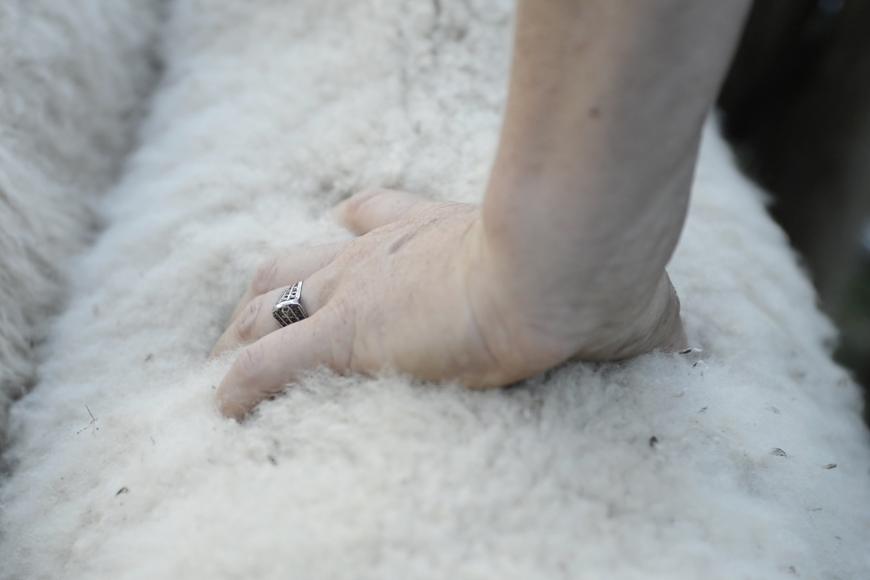
The sounds made by a ewe when a lamb is born seem almost human. And when a little later the newborn turns out to be unwilling to live it seems as if one could detect pain in the mother’s eyes. The shepherdess Nathalie’s empathic look at her flock was transferred directly to the viewer. Each animal here has its own name, each has a biography that Nathalie knows by heart. And it’s ultimately up to her to finally decide when the end of a sheep is near. In diary-like sequences we learn about her feelings, take part in a difficult process of development which results in new self-confidence, perhaps even new wisdom. Elsa Maury shows a perennial school of killing and death. She leaves the events uncommented, but achieves an intensity through images and editing that stays with us for a long time.
Carolin Weidner
Credits
Director
Elsa Maury
Cinematographer
Christian Tessier, Martin Flament, Elsa Maury
Editor
Geoffroy Cernaix, Pauline Piris-Nury
Producer
Cyril Bibas
Co-Producer
Luc Reder, Olivier Burlet, Javier Packer-Comyn
Sound
Marc Siffert, Loïc Villiot, Galaad Germa, Willy Boutet, Elsa Maury
World Sales
Philippe Cotte
Narrator
Nathalie Savalois
Nominated for:
Prize of the Interreligious Jury,
FIPRESCI Prize
A stock car race that leaves only the carcasses of cars in the end. From offscreen, the director talks about a violent relationship. A metaphor, as precise as knife stabs.
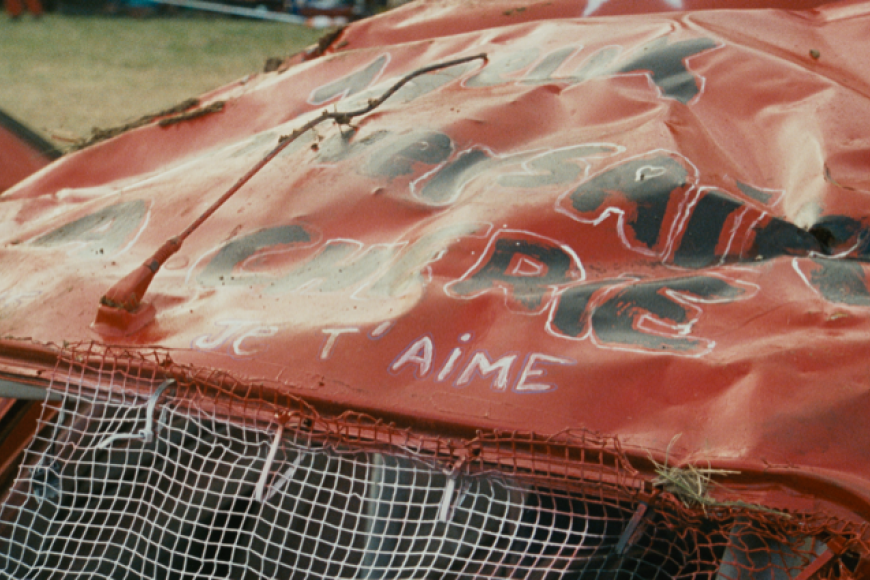
Summer, dust, a burning sun. It is stock car race season, a loud, aggressive show that leaves only smashed carcasses of cars in the end. After each lap, the dents are worked over with heavy hammer blows before the damaged racing cars are sent back on the smoky track. The audience are standing at the edge of the sand pit and can’t get enough of the pile-ups. From off screen, the director gives a matter-of-fact account of the violent relationship in which she got caught up at the age of 18 and from which she only managed to free herself two years later. She analyses precisely what happened to her back then, using the dented, destroyed vehicles as a powerful metaphor for her injured body. The interplay of images and words is spot-on – like precisely placed knife stabs.
A man on an e-scooter on the outskirts of the city. Only the rifle over his shoulder irritates. The mood of high alert is deceptive. The disaster has already happened.
On the outskirts of the city, the new modern buildings are silent and the motorway bridge drones. Birds are circling in the sky, a young man, concealed by his hoodie, is riding his e-scooter along a park path. The only irritating element is the rifle over his shoulder.
Anton Cla’s film depicts a mood of high alert, while the disaster has in fact already happened. Unexplainable scenes that could not be more disconcerting and grow increasingly drastic unfold calmly. The screaming silence is decisively enhanced by the imperceptibly accumulating mixed drone of the daily sounds of a mechanised world: motorway, tramway, clicking indicators, pulsating emergency signals. What the soundscape adamantly refuses to deliver is a loud discharge that would release the tension. The suburban landscape is steeped in a red theatrical warning light, blurs restrict the view. The 3D computer design masks neither the artificiality nor the computer-based deformations of the images of a normality that has become a combat zone – the machine matrix seems to rule already.