Press Area
All year round we inform interested journalists about the latest news at DOK Leipzig. On this page you will find our press releases and information about press materials.
Photos and Logos
You can download press photos, portraits and logos from DOK Leipzig here:
Press Conference (in German)
Wednesday, 7 October | 3 - 5 PM
Basislager Coworking, Peterssteinweg 14, 04107 Leipzig
Please sign up for the press conference via e-mail until Monday, 5 October.
Press Mailing List
Please contact us and we will add you to our press mailing list:
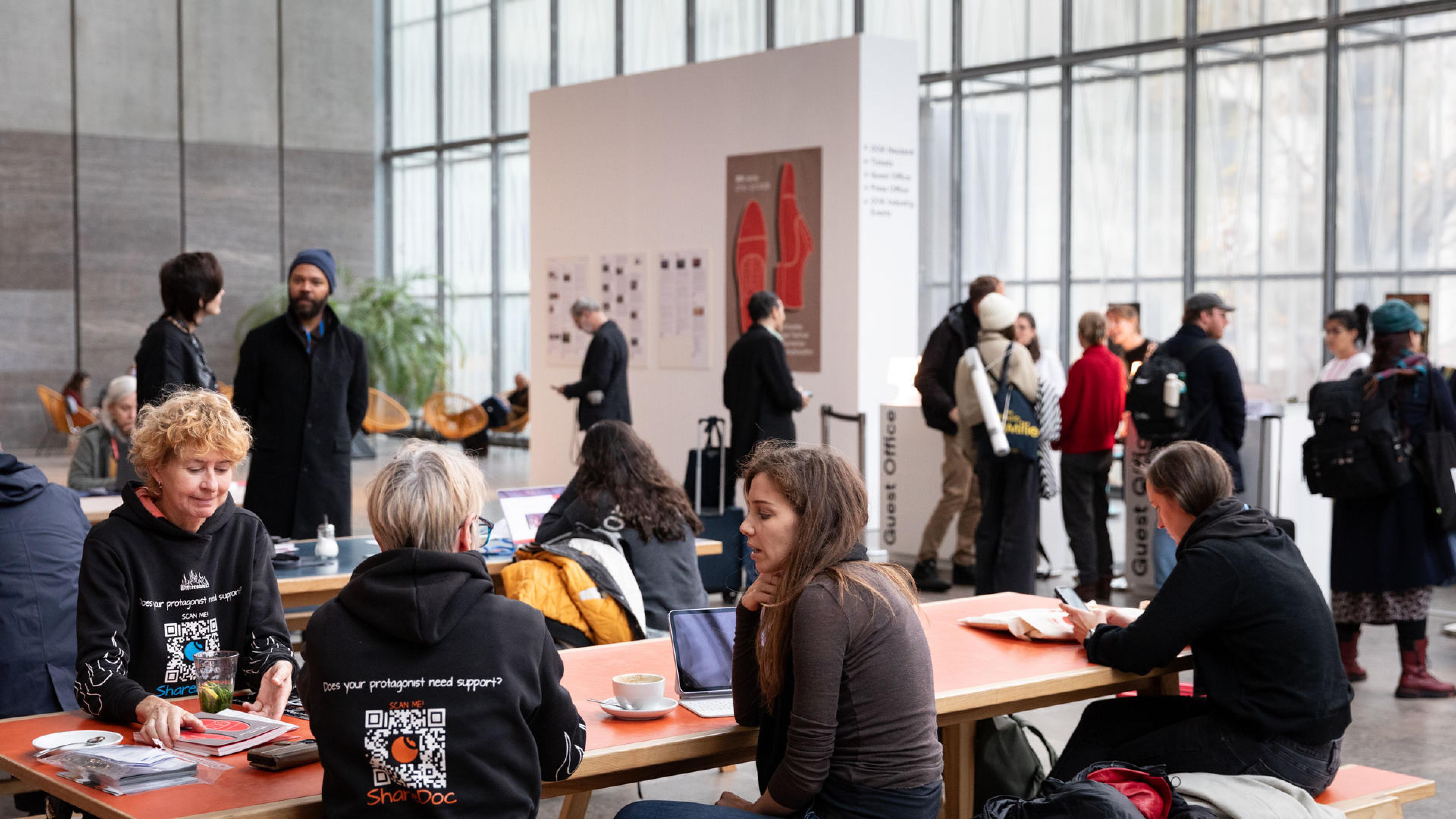
Press office at the festival center
During the festival week, our press office will be located in the festival centre (Museum of Fine Arts, MdbK, Katharinenstraße 10).
Opening hours:
Monday – Saturday (26 – 31 October)
9:00 – 18:00
Sunday (1 November )
10:00 – 14:00
Alena Flemming, Maren Fußwinkel, Sevara Pan, Julie-Madeline Simon
presse [at] dok-leipzig [dot] de (presse[at]dok-leipzig[dot]de)
+49 (0)341 30864-1070
Journalists who cover the festival as reporting press will be accredited to DOK Leipzig free of charge. Please provide as much detail as possible about your planned coverage. We reserve the right to request proof of the journalistic work and to possibly refuse a free accreditation in individual cases.
Important note for photographers and videographers:
Your press accreditation does not automatically grant you permission to take photos or record videos at the festival. Please indicate on the accreditation form under ‘Coverage’ if you wish to take photos or record videos, and additionally contact the press office before the festival begins to provide details of your specific plans.
Accreditation Form:
To request your press accreditation, log in to your myDOK account and fill out the following form:
With your press accreditation you gain access to:
DOK Leipzig Film Programme:
- Free tickets for screenings of the entire festival programme
- Online access to selected films of the festival programme, from 26 October to 8 November 2026
DOK Industry Programme:
- Access to insightful live talks, project presentations, conferences, master classes, DOK Archive Market, DOK Exchange XR Conference, Get Togethers and more
- Online access to event livestreams / recordings
- Industry Guide: our comprehensive guide of industry professionals to help you network, fund and circulate your new films and projects in development
How to watch films online with your press accreditation:
You can watch a selection of films from our programme online from 26 October to 8 November 2026.
Log into your myDOK account and select the film in the programme overview. The embedded player is located below the screening times.
You do not plan any coverage?
In this case you can apply for regular accreditation for a fee. All information can be found here: Accreditation
Press Releases 2026

With a news cycle churning endlessly through conflicts, climate crises, and violence, our sense of stability is eroding. Held under the theme “Landslide”, DOK Neuland, the public extended reality (XR) and expanded filmmaking exhibition, maps collapse across eight compelling works, revealing its many facets, fractures, and promises. Curated by Dana Melaver, the works span a range of themes and narrative approaches, from man-made tensions with nature, to homes lost to climate change and violence, to departures from certainty and new beginnings. The lineup boasts diverse forms, featuring three VR/MR experiences, two 360° films, two mixed media installations, and a performance special event.
The public exhibition is accessible to visitors free of charge from 27 October to 1 November 2026 across several venues. While most works are on view at the main venue Kohlrabizirkus, two special programmes, DOK Neuland Presents, are featured on the ground floor of Leipzig’s Central Station and at Heilandskirche/Westkreuz.
Ana P. Santos, an award-winning journalist whose work typically centres on the intersections of gender, sexuality, and migrant rights, presents an immersive reportage, “Living in Water” (2025), exploring the intimate impacts of climate change. Set in Isla Tibaguin, Philippines, one of the world’s most climate-vulnerable countries, this 360°/VR experience documents life where flooding has become routine and floodwaters, brought in by tides, creep into homes almost daily.
Following Germany’s Murg river in the course of three years, the expanded documentary project “Becoming River” (2026) by Adrian Schwartz, Daniel Fetzner, and Ephraim Wegner captures a landscape where nature and human infrastructures inevitably intertwine. Impressions, featuring the river, construction sites, dams, and people, coalesce across projections, screens, sound, and live data interpretations.
In a delicate exploration of what remains after calamity, the deeply affecting VR documentary “The World Came Flooding In” (2025) by Isobel Knowles and Van Sowerwine crafts a miniature world filled with lost objects and spaces, recreated based on testimonies of people affected by the 2022 floods in eastern Australia.
Digital objects, too, are vulnerable to loss. In the installation “Permanence of Decay” (2026), multidisciplinary designer Pranav Chaparala challenges the supposed immortality of data, reimagining it as a fragile being with a finite lifespan. Through a physical console, the visitor actively engages with the system, composed of a photographic archive, deciding whether to slow the decay of images or accelerate their demise.
Meanwhile, “The Room of a Thousand Voices” (2026) by Cologne-based Cuban media artist Pavel Mendez Hernandez draws the visitor into a room that unfolds as a Cuban lived-in home over one accelerated day. Unleashing senses, memory, and imagination, this single-user Mixed Reality installation places the visitor (via a VR headset) into a darkened space where they move through a 1:1 physical room, while the virtual layer restores the house as it once was and the hands meet its materiality.
Keren Manor and Faiz Abu Rmeleh of Activestills, an independent photography collective “engaged in decolonial struggles in Palestine/Israel”, present “We Shall Return” (2026), co-produced by B’Tselem and the award-winning XR studio NowHere Media . Blending visceral 360° cinematography and phone and handycam footage filmed by Palestinian residents and activists, it is a disturbing documentation of forced displacement in the West Bank, centered on first-person accounts of Palestinians under constant pressure by Israeli forces and settlers.
This year’s DOK Neuland features two special programmes, DOK Neuland Presents. In “Nothing to see here” at Leipzig’s Central Station, the visitor journeys into the unexpected inside a secret world in a central train station. “What if Hildegard von Bingen Was a Wellness Influencer” at Heilandskirche/Westkreuz offers a singular experience, collapsing time and musical traditions, with two church organs, played by AI-driven robots, forming a duet and performing to a score composed live with the audience. This event will be held only twice, with prior registration required. Several special events are also set to take place, further contextualising the exhibited works, including musical activations of “Becoming River” and talks with DOK Neuland artists.
This year’s DOK Exchange XR, the Industry programme for interactive and immersive storytelling, focuses on shifting practices of archiving XR and immersive works amid AI and sweeping tech advancements. DOK Exchange XR (the XR Conference, XR Showcase, and XR Prototyping Zone) takes place on 29–30 October. It is preceded by a special programme on 28 October, DOK Exchange XR Encounters, a new format introduced this year in collaboration with Kunstkraftwerk Leipzig, which will discuss and showcase their immersive practice and work with archives. This year, DOK Exchange XR works closely with Saxony experts and game/XR studios, along with the British Council, the French Institute as part of Novembre Numérique, the Creative Europe Desk Berlin-Brandenburg, and other partners.
Also new in this edition is a DOK Exchange XR Think Tank, held as part of DOK Exchange XR’s continued partnership with CPH:DOX/LAB. The Think Tank “Digital Archives in Transition: From Current Practices to Cultural Resilience in Audiovisual & Immersive Storytelling” explores current and emerging models for archiving XR, as well as a rising need for resilience in times of AI and rapid tech change.
Alongside a full slate of panels and keynotes, this year’s XR Conference introduces a masterclass format, dedicated to advancing the conversation around archiving and preserving complex XR and hybrid works. Joanna Kaliszewska, a digital archivist at Poland’s National Film Archive – Audiovisual Institute (FINA), holds a masterclass on digital preservation and the role of archives in safeguarding our audiovisual memory. Among other highlights is the panel “Living Archives: Preserving (Extended) Realities in the Age of AI”, moderated by artist and XR industry expert Sara Francesca Tirelli.
The XR Showcase features four projects. In a collective brainstorming session, involving a panel of experts from across research, funding, production, distribution, art, and technology, the creators have the opportunity to exchange perspectives on their projects and co-develop solutions.
A total of four prototypes are presented at this year’s XR Prototyping Zone, where experts, distributors, and industry professionals test the works-in-progress in regards to interactive elements, narrative solutions, and user interaction. As DOK Exchange XR looks ahead to ambitious new forms of immersive storytelling between XR, games, XR, and AI, this year’s prototypes also bring forward experimental forms, including an interactive narrative using EEG devices and a 2D interactive game drawing on traditional animation techniques.
Extending this year’s archival focus, the DOK Industry Podcast has released a fresh episode, “Bringing Archives to Life Through Immersive Storytelling”, which brings in Chloé Lee and Lucy Hammond whose works were first pitched at the DOK Exchange XR Showcase and have since grown into internationally recognised works, “Inter(mediate) Spaces” and “Ôl ( Haunts)”, respectively. The creators join host Weronika Lewandowska (curator and coordinator of DOK Exchange XR) in tracing their projects’ journeys and discussing their creative methodologies and challenges of working with archives in XR.
DOK Exchange XR is supported by the Creative Europe Desk Berlin-Brandenburg, the British Council, and the French Institute as part of Novembre Numérique. Among the programme partners are Kunstkraftwerk Leipzig, National Film Archive – Audiovisual Institute (FINA), Games & XR Mitteldeutschland, MOIN Filmförderung Hamburg Schleswig-Holstein, NewImages and CPH:DOX/LAB.
The panel “Beyond the Downturn: New Paths for Games & XR in Europe” takes place in partnership with Games und XR Mitteldeutschland. The masterclass “Budgeting and Business Planning for XR Productions” is held in partnership with MOIN Film Fund Hamburg Schleswig-Holstein.
DOK Neuland came to life again through the support of Sächsische Medienanstalt (SLM), Mitteldeutsche Medienförderung and MDR Media. The Embassy of the Kingdom of Netherlands supports the work "Nothing to see here".
DOK Industry is realised with the support of Creative Europe MEDIA Programme of the European Union, the Mitteldeutsche Medienförderung (MDM) and the Federal Government Commissioner for Culture and the Media upon a Decision of the German Bundestag.
DOK Industry is funded by the European Union. Views and opinions expressed are however those of the author(s) only and do not necessarily reflect those of the European Union or the MEDIA sub-programme of Creative Europe. Neither the European Union nor the granting authority can be held responsible for them.
DOK Leipzig would like to thank all supporters of the festival.

DOK Leipzig has announced the full DOK Industry Programme for its 69th festival edition (26 October – 1 November). This year, the DOK Industry Programme offers a vibrant mix of formats and activities that engage with key industry topics, foster creative exchange, and provide filmmakers with a space to showcase their work and build lasting connections within the international community. Find the entire Industry Programme and Timetable on the website.
DOK Leipzig upholds its commitment to supporting documentary filmmakers and their vital work amid rising political instability and threats to freedom. In line with these efforts, DOK Leipzig will hold the DOK Industry Talk “Doc Together: When Freedom of Expression is at Risk” as part of its joint initiative with the Thessaloniki International Documentary Festival, Doc Together. The panel will examine the escalating pressures on press and media freedom across Europe and explore how documentary filmmakers, journalists, and institutions can collectively respond. Moderated by Julie Nederkoorn, head of International and Industry at Movies that Matter, a leading human rights film festival in The Hague, the discussion will be joined by Andreas Lamm, managing director of the European Centre for Press and Media Freedom (ECPMF) and Bente Roalsvig, deputy director of the Fritt Ord Foundation, dedicated to advancing freedom of expression, public debate, art and culture.
The DOK Industry Talk “Making Space for Queer Cinema – The Curators’ Role” seems ever more timely as queer filmmaking faces mounting political and social pressure across the world. The panel will highlight the importance of challenging mainstream depictions of queerness and the crucial role film festivals can play in promoting intersectional storytelling within their programmes. Working toward culturally informed and accurate portrayals of Romani people, the Romani Filmmakers Network (RFN) and the Critical Film & Image Hub will host the DOK Industry Workshop “Building a Framework for Respectful Romani Representation”. The workshop will trace the history of antigypsyism in cinema and introduce a framework for respectful Romani representation, followed by an interactive session that will gather feedback for its ongoing development. The workshop will welcome Lisa Smith, co-founder of RFN and research associate at the Critical Film & Image Hub, Alica Sigmund Heráková, producer and co-founder of RFN, and Dr. Andra-Octavia Drăghiciu, research associate at the Critical Film & Image Hub.
The “Generation Africa 2.0” Rough Cut Presentation is yet another spotlight in the programme. Seeking to amplify African voices and actions in the ongoing climate crisis across the African continent, Generation Africa 2.0 brings to Leipzig five works-in-progress from across Senegal, the DR Congo, Kenya, and Benin. Generation Africa 2.0 is an initiative by the South African non-profit media company STEPS, supported by ARTE and Deutsche Welle, that aims to produce films from 21 countries in Africa. Meanwhile, the DOK Industry Talk: “Community and Alternative Cinema Spaces and Practices” will look at alternative approaches to film exhibition and distribution, exploring cinemas conceived as or transformed into spaces of encounter, social discourse, and community. Among the speakers joining are Eric Hynes, director of film curation and programming at the Jacob Burns Film Center, and Can Sungu, co-founder and artistic director of bi’bak and Sinema Transtopia.
DOK Leipzig reinforces its focus on animation while forging a stronger link between animation and documentary within its programme. Marking its 4th edition, the Animation Lab DOK Leipzig takes place again in collaboration with CEE Animation. Led by seasoned producer Jean-François Le Corre (Vivement Lundi!) and multidisciplinary artist Uri Kranot (Tindrum), the three-day workshop will equip producers developing their first animated documentary with knowledge and skills to navigate the international animation industry, from development and pre-production to distribution.
Hosted by Marky Sparky Media founder Mark Taynton, the Roundtable “Adult Animation Roundtable” will bring together creators, producers and industry experts to address the current state of adult animation, structural gaps limiting its growth, and the actions needed to increase its visibility and create a practical path forward for the sector in Europe. This roundtable is the second installment of an ongoing joint initiative between DOK Industry and Animation Production Days (APD). The visibility of European animation is also explored in a dedicated panel, hosted by DOK Leipzig’s partner ASIFA Germany (AG Animationsfilm). “From the Niche into the Spotlight – Pathways to Greater Visibility for European Animation” will identify approaches to expanding the reach of animated features and shorts, as well as measures festivals, cinemas, distributors, media, and associations can take to elevate their presence. Finally, this year’s Animated Film Hommage and Masterclass will celebrate Trollfilm, a prize-winning Norwegian studio founded by Anita Killi, known for its cut-out multiplane animation. Find out about the programme in the press release.
The Industry Programme features several events organised by DOK Leipzig’s partners. Among the highlights is the panel organised by AG DOK, “Between Target Audience Orientation and Public Service Mandate: ARD’s Decision-Making Structures and the Evolution of Documentary Programming in the Streaming Era”, which will examine the broadcasters’ strategic shifts to online media libraries, the consequences of such decisions on documentary programming, and how they align with the public service broadcaster’s statutory mandate. The talk will be held in German, with author René Martens and filmmaker and professor Susanne Binninger (AG DOK) presenting the analysis and discussing it with experts.
The DOK Archive Market marks its fifth edition this year. Among this year’s exciting offerings at the DOK Archive Market is the panel “Replatforming – AI and its Ethics for Archives, Producers and Archive Researchers”, probing the ethical stakes involved in working with archival footage in the context of AI.
Short n’ Sweet, the festival’s short film pitch, has unveiled a fresh crop of projects, ranging from short documentaries to animated documentaries and animated films. During Short n’ Sweet, Guardian Documentaries and arte.tv will announce the winner of their pitch ‘Democracy at Stake in Europe’, aimed at supporting short documentaries exploring the state of democracy today. DOK Preview Germany and DOK Preview International will announce the 2026 lineup of projects on the website shortly.
At Industry Intros, accredited guests will have the opportunity to gain insight into certain aspects of the industry, from the working practices of sales agents to distribution and marketing strategies. The session “Equitable Co-Productions” will introduce the Value-Based Co-Production manual, co-published by the International Media Support (IMS) and the National Film School of Denmark, rethinking international co-productions and the ways ownership and revenues are shared, especially when partners operate in different production economies. At Industry Connections, accredited professionals will have the chance to meet with representatives of training initiatives in a roundtable format, and in one-on-one sessions with archive researchers and producers, sales agents and distributors, as well as festivals and markets.
Find the full Industry Programme: DOK Industry Programme A-Z
All dates and events: DOK Industry Timetable

Whether a cheeky little penguin or an intrepid mouse, the heroes of these stories rise to the challenge and, with a little help from their friends, achieve the impossible. This year, Young DOK is once again showing a selection of diverse and age-appropriate documentary and animated films, inviting audiences young and old to dream and reflect.
The section is made up of Kids DOK—for our youngest film buffs, of nursery and primary school age—and Young Eyes, which features films for teenagers. Alongside German productions and films with no dialogue at all, international titles will be screened with subtitles.
Kids DOK showcases short, animated fantasy stories and relatable everyday situations. The programme is curated with three age groups in mind:
Children aged 3 and over can look forward to a lineup of short films starring adventurous mythical creatures such as a dancing caterpillar, a mouse on an epic journey and a cloud-fish. The preschool programme for ages 5 and up celebrates the joy of friendships and shared experiences—whether racing along on bikes, hiding deep in the jungle, or searching for the last autumn leaf. The 8+ programme for primary school children centres on unusual connections, finding courage and overcoming personal challenges. Across the three animated and documentary films, Szymon and Franek meet at the skate park, Jools learns to dance with a disability, and Paul deals with the grief of losing his dog by creating comics.
Young Eyes will screen four feature-length documentaries for young audiences aged 12+, opening a window onto the different daily realities faced by their peers. The protagonists spend long summer days at the outdoor pool, study at hotel management school or train for their big dream. Growing up confronts everyone with many decisions and, above all, poses one central question: Who am I, and who do I want to be?
The Youth Jury decides which of the films will receive a special honour and presents the Young Eyes Film Award, sponsored by the Rahn Dittrich Group for Education and Culture.
Film education: A class of its own
DOK Leipzig also offers university students, school pupils and teachers a range of opportunities to actively take part in the festival week and is committed to promoting media literacy. The DOK Education programme includes Teachers’ Day, a professional development initiative for educators, as well as exclusive film screenings and guided tours of the extended reality exhibition DOK Neuland for school groups.
In collaboration with the Academy of Fine Arts Leipzig (HGB) the HGBxDOK Film School Night will be taking place on 28 October 2026, once again showcasing short films by students. New this year is the addition of a selection and preparation committee made up of Leipzig students. Besides promoting visibility and opportunities for dialogue, the internal screening allows students to gain practical experience in event organisation and film curation.
On Wednesday 28 October at 11:00, pupils aged 12 and over can attend the screening of “Moving Sisters”, which is being shown as part of the Young Eyes programme. The documentary tells the story of three sisters who fled Afghanistan and now live in Leipzig, where they attend (or have finished) school. Shot over a period of seven years, the film captures the fragile normality that Nazieh, Shazieh and Hanieh built for themselves with their father in a refugee camp in Athens, after a new law blocked their planned family reunification with their mother in Germany.
In cooperation with SchulKinoWochen Sachsen, DOK Leipzig will present “Moving Sisters” both as a school screening and as part of Teachers’ Day.
Teachers’ Day will take place on Thursday 29 October, 10:00–18:00, at the Polish Institute in Leipzig. Organised in cooperation with VISION KINO, this free training session introduces cinematic storytelling and creative approaches to filmmaking. Following the screening, participants will work together to develop teaching methods that incorporate documentary film into the classroom setting.
What’s it like to step into the shoes of a journalist, watch films and interview the directors afterwards? That’s what the DOK Spotters programme is all about. Young people aged 14 to 20 will be covering the festival week with their own reports, reviews and interviews. In workshops, participants will learn the fundamentals of journalism, before having the chance to apply them independently at the festival.
Overview of the films of the section: Film Lists 2026
Press images available to download: Film stills

At this year’s DOK Leipzig festival, two feature-length documentaries and one short animated film will be presented with audio description. This has been made possible with the support of Greta und Starks and Kinoblindgänger gemeinnützige GmbH.
Another 26 films will be shown with simple German subtitles, further improving accessibility to parts of the festival. Around half of these subtitles have been supplied by the filmmakers themselves, while DOK Leipzig has produced the remainder specifically for the festival with the help of AI.
In addition, one feature-length film and one short film will be presented together in a Relaxed Screening at CineStar 2. These screenings are designed to provide a more accessible and inviting cinema experience for people with different sensory needs. The auditorium remains softly lit, audience members can move around freely, and filmgoers can leave and re-enter the auditorium. There is no expectation of absolute silence; audience reactions and other sounds are welcome.
Thanks to support from Diakonie Leipzig, a free companion service for blind and visually impaired people and wheelchair users will once again be available this year. Those wishing to use the service can contact Susann Hanske in advance on +49 (0)341 5612-1290 or send an email to fbti [dot] begleitung [at] diakonie-leipzig [dot] de (fbti[dot]begleitung[at]diakonie-leipzig[dot]de).
DOK Leipzig has been showing films in accessible versions for many years. Until two years ago, these services were funded by the Free State of Saxony. This funding was completely cut for the 2025/26 two-year budget and not replaced. Since 2025, DOK Leipzig has therefore relied on filmmakers or sponsors to provide accessible versions of films. With its finances already under considerable strain, the festival is unable to draw on its own resources to cover the costs of SDH subtitles (for the Deaf and Hard of Hearing) and additional audio descriptions.
For comparison, in previous years, project funding from the Free State of Saxony enabled around 35 films per festival edition to be made accessible. It also meant that three to five Q&A sessions could be provided with sign-language interpretation.
The majority of the above mentioned screenings will take place at CineStar 2. The full programme, including all screening times, will be available on the DOK Leipzig website from 8 October, when online ticket sales will also open.

Each year, DOK Leipzig invites an esteemed group of filmmakers, artists, and industry experts to join the juries celebrating the most outstanding achievements in documentary and animated film. With deep appreciation, DOK Leipzig welcomes the juries for its 69th edition, who will lend their expertise and sensibilities to recognise this year’s finest works.
The jury for this year’s International Competition Documentary Film features Raul Niño Zambrano, Ivan Ramljak, and Diana El Jeiroudi, who will choose the winner of a Golden Dove for best feature documentary and best short documentary from the 9 nominated features and 13 nominated short films. They will also select the recipients of a Silver Dove for best feature documentary and best short documentary by an up-and-coming director.
Bringing a wealth of experience in programming and curation of innovative, socially engaged programmes, Raul Niño Zambrano joins the international jury. As creative director at Sheffield DocFest, he has steered the festival’s artistic direction and programming since 2023, spearheading the launch of TV documentary series premieres, the innovative Podcast Pitch, and the Queer Realities Director’s Lab, providing LGBTQIA+ filmmakers with a space to advance bold, boundary-pushing queer non-fiction storytelling. Before joining Sheffield DocFest, he served as a Senior Programmer at IDFA, where he started in 2008. His fellow juror is Ivan Ramljak, a Croatian filmmaker with an impressive slate of documentaries that have screened at over 100 festivals and garnered numerous accolades, including most recently “Peacemaker”, which snagged the Golden Dove at DOK Leipzig 2025. Beyond his filmmaking, he established the Human Rights Film Festival in Zagreb in 2003, curated the “Short Tuesday” film programme at Cinema Tuškanac between 2013 and 2022; and served as artistic director of Tabor Film Festival until 2023. The jury is reinforced by Diana El Jeiroudi, a Berlin-based Syrian director and producer, and a co-founder of No Nation Films and DOX BOX. Drawn to documentary film where form and politics inextricably intertwine, she produces compelling works, marked by political resonance, formal sensibility, and the lived depth of personal histories. Her body of work includes “Silver Water, Syria Self-Portrait”, which world-premiered at Cannes 2014, and Venice-debuting “Republic of Silence” (Goethe-Institut Documentary Film Prize 2021), which she directed. Committed to championing diverse voices, she mentors filmmakers at international labs, including Berlinale Talents. She is a member of the Academy of Motion Picture Arts and Sciences and the German Film Academy.
The jury for the German Competition Documentary Film comprises Stefanie Eckert, David Bernet, and Adele Kohout, who will pick the winners of a Golden Dove for best feature documentary and best short documentary from the 8 nominated features and 12 nominated short films.
Lending his discerning eye and critical perspective is German-Swiss documentary filmmaker David Bernet, known for his inventive engagement with social and political issues. His repertoire features “Solidarity”, “Democracy”, and “Raising Resistance”. Since February 2020, he has been co-leading AG DOK as managing director and chairman of the Board. With experience in a different part of the film landscape as DOK.fest München’s festival director, Adele Kohout brings a deep understanding of the industry ecosystem. Before taking on artistic direction and management in 2025, she co-helmed the festival with Daniel Sponsel and had worked in various other capacities. Rounding out the jury is Stefanie Eckert, managing director of the DEFA Foundation since 2020, who draws on her extensive expertise in film heritage while navigating cultural and political challenges tied to it. One of her key focuses is integrating DEFA cinema into academic discourse while making its film heritage accessible to broader audiences.
The jury for this year’s International Competition Animated Film includes Waltraud Grausgruber, Edmunds Jansons, and Matea Radic, who will select the winner of a Golden Dove for best animated feature and best animated short film from the 5 nominated features and 19 nominated shorts.
Co-founder of Tricky Women Tricky Realities in Vienna, known for its distinct focus on animated films by women and/or genderqueer artists, Waltraud Grausgruber advances her commitment to opening up the medium to new, vibrant forms of dialogue and critical engagement — efforts that she deepens with Culture2Culture, pushing animation into educational, activist, and civic spaces. Joining the jury is Edmunds Jansons, an award-winning Latvian animation director, whose works are shaped by formal playfulness, rooted in Baltic animation traditions. Spanning short films, television projects, and feature films, his work includes “Choir Tour” (2012), “The Isle of Seals” (2014), “Guard of Honour” (2021), “Freeride in C” (2024), and “Born in the Jungle” (2026), which debuted at the Annecy International Animation Film Festival earlier this year. Beyond filmmaking, he is also the founder of the animation studio Atom Art and a well-known children’s book author and illustrator. Completing the jury is multidisciplinary artist Matea Radic. Born in Sarajevo and based in Winnipeg, Canada, she traverses geographies and artistic fields in her practice, from animation to directing, painting, and sculpting. Her 2025 film “Paradaïz” scooped a Golden Dove for best short animation film, telling a wistful tale of a return to childhood during the Bosnian War, punctuated by “exploding tomatoes and bullet-riddled walls”.
Recipients of a Golden Dove for best animated short film as well as those awarded in the International Competition Documentary Film qualify for nomination at the annual Academy Awards, provided they meet the Academy’s requirements.
This year, the winner of a Golden Dove for best feature documentary in the Audience Competition will be decided in an online vote.
DOK Leipzig’s coveted Golden and Silver Doves will be presented to the winners during the awards ceremony on 1 November at Schaubühne Lindenfels.

Festival director Ola Staszel is introducing a new section called “Fokus Ost”, which will bolster eastern German perspectives in documentary filmmaking. This marks the addition of a further section alongside “Positions” to expand DOK Leipzig in Staszel’s first edition of the festival.
“The voices from the eastern part of our country are not always heard. Giving them greater exposure in a place like Leipzig and at a festival with such an eventful history marked by profound political upheavals is something that should be expected,” says Staszel. “The films being screened originate here, but their relevance extends further. We hope that they will reveal their discursive power, particularly through dialogue with our international audience.”
Curator Grit Lemke, a filmmaker, author and former programming director at DOK Leipzig, adds: “It’s about filling a void, about correcting perceptions and providing alternate narratives. It’s about asking why the variety of eastern Germany isn’t reflected in what’s seen or told – and who makes that decision. It’s about self-reflection – in the face of profound changes.”
The feature-length films tell, among other things, of the student protest in Rostock against the closure of the branch of the Ernst Busch Academy of Dramatic Arts during the period of German reunification (“The Class of 1990”), the stories of two former contract workers from Vietnam who were employed in the GDR (“Uncle Thuận”) and a garden that becomes a bright spot within a concrete housing estate in Schwerin (“Garden of Hope”). While one of the short films takes us to the eponymous “Silicon Saxony”, “Ten to Twenty Slag Heaps” is a cinematic, associative exploration connecting the landscape, history, legends and identity of the Mansfeld region.
Four other films in this section will be entered in the German Documentary Film Competition and will be announced on 8 October.
Eight of the total of ten documentaries will have their world premieres at the 69th edition of the festival. These include this year’s opening film: Ina Borrmann’s “Good Evening, Beautiful” completes the new section.
The film’s director, who was born in Saxony, met several protagonists of a 1977 collection of interviews by Maxie Wander titled “Guten Morgen, du Schöne”, and interviewed them again. Wander’s book had left its mark on generations, and it remains one of the most influential works in German literature. Then as now, the women – originally anonymous, now using their real names – reflect quite openly on their lifestyles, work, relationships, the GDR era and the present day, their families, their sexuality, their age and their place in society. By speaking with radical candour about matters that are supposedly private, “Good Evening, Beautiful” once again raises important questions about living in a patriarchy, questions that have lost none of their relevance since the book was first published.
To coincide with the festival’s official opening on 26 October at the Schauspiel Leipzig, there will be a public screening of “Good evening, Beautiful” at 20.30 in the East Hall of Leipzig Central Station. Admission is free.
The section will also include the DOK Talk “Eastern German Perspectives in Documentary Filmmaking” at the Volkshochschule Leipzig at 16:00 on 30 October, which is being organised in collaboration with the weekly newspaper “der Freitag”. How are eastern Germany and the realities of life there represented in documentary films? What obstacles do filmmakers face? And which films make it onto the big screen, onto television and onto streaming platforms? In conversation with guests of this edition of the festival, DOK Leipzig aims to take stock of the current situation and open it up for debate. The talk will be moderated by Barbara Schweizerhof, film editor at “der Freitag”. This event is also open to the public free of charge.
The full programme, including all screening times, will be available on the DOK Leipzig website from 8 October. Ticket sales will open online on the same day.
“Good Evening, Beautiful” opens in German cinemas on 19 November.
The first films in the section at a glance: Film Lists 2026
Press images available to download: Film stills and portraits

The 22nd edition of the DOK Co-Pro Market welcomes 35 projects from across 34 countries looking to connect with new international financing and co-production partners. The DOK Co-Pro Market continues to draw sustained interest from filmmakers, with a record number of animated documentary and animation entries. This year’s selection sees a wide geographic spread, spanning all continents and featuring countries typically less represented in the international film arena, including the DR Congo, Namibia, Palestine, Kazakhstan, and Nigeria. Women filmmakers also maintain a strong presence in the lineup, comprising 50 percent.
As the world wrestles with deepening crises, the selected projects reaffirm film as a vital political art form. Among the prominent themes shaping the lineup are reckonings with (colonial) pasts, struggles for bodily autonomy under hostile states, Indigenous resistance, and socio-political upheavals. Personal storytelling, including first-person accounts mining family archives and memory, remains an essential mode for many filmmakers to probe broader historical narratives.
Across the selection, several projects examine the enduring control exerted over women’s bodies. Weaving archival footage, first-person testimony, and 2D animation in “I Am Every Woman”, the director duo Ruxandra Gubernat and Maria Stanisheva, born in Romania and Bulgaria under communist regimes, map their experiences of reproductive oppression and the new mechanisms governing women’s bodies today. The recurring fates of women are also at the centre of Ruben Mayoko and Junior Mozese’s “Abeti”, following an eponymous heroine in Kinshasa as she grapples with predicaments shared across her family, from single motherhood to sex work. Meanwhile, Juyeon Yang’s “Neither Shadow nor Light” confronts “a fossilised past” of sexual violence of the 1980 Gwangju Uprising as an incisive, ongoing question in a lawsuit.
Rather than following migrant journeys, a number of projects explore displacement through something closer to home: the infrastructures and spaces that shape our daily lives, such as shopping centres, factories, and classrooms. Syrian filmmaker Rami Farah’s “A1” (prod. Signe Byrge Sørensen/Final Cut For Real behind “The Act of Killing” and “The Look of Silence”) transports the viewer to a Paris classroom of refugees, reflecting on the difficulty of learning French as a consequence of exile. Max Kerkhoff’s “Snails” (prod. Zorana Mušikić and May Odeh/Mayana Films behind “Aisha Can’t Fly Away” in Un Certain Regard at Cannes 2025) plucks the viewer into Chile’s dazzling spiral-shaped shopping centres – “caracoles” or “snails”, opened during the 1970s/1980s neoliberal boom – which are now inhabited by people left behind by the globalised economy. In Shorena Tevzadze’s “Concrete Grassland”, a couple in Tbilisi is driven into a different kind of exile, by their country’s neglect, with the family stuck in limbo, waiting for their unfinished flat, while Georgia moves through cycles of unrest, protests, and war.
Themes of land dispossession and Indigenous resistance resonate across several projects. Chronicling the efforts of three Mapuche siblings in southern Chile, Loreto Plubins’ “Folil” highlights the persistence of their fight to safeguard their ancestral land, carrying on their parents’ struggle against the state and corporations from the 1940s. Further north, Lea Schlude and Matthew Teutimez’s “Hazy Valley” challenges narratives imposed on another land, now known as Los Angeles, built on the unceded territory of the Kizh and other peoples. Meanwhile, Abdel Mandili’s “The Birds Still Sing Here” interrogates the silence pervading history on the island of Lovongai in Papua New Guinea, where 12 Indigenous clans were drawn into a civil war over land disputes, fuelled by foreign extractive mining and logging.
This year’s crop features a diversity of forms, ranging from hybrid works that use magical realism (Jumana Manna’s “Jerusalem Boys”, SEERA Films), to dual-timeline narratives (Almira Saifullina’s “Dala”), to investigative projects that examine today’s political realities and legacies through a searching lens (Chiara Sambuchi’s “Kim”, prod. Gregor Streiber/inselfilm behind “Listy (Letters from the Silenced Country)” at Venice 2026). The selection includes animated documentary projects, some of which use animation to depict interiority and trauma typically inaccessible to live-action footage (Joel Kachi Benson’s “The Road to Bama”, Claudia Tosi’s “The Spectres of the Camp”), as well as a feature animation – new in 2026 (Gao Yuan’s “Cloud of the Unknown”). Also present in the lineup are archival projects that engage with sourced archives, such as Lucas Weglinski’s “Hunting Season”, Yaela Gottlieb’s “Je Vous Salue, Peru”, and Brina Klampfer Merčnik and Miha Možina’s “Paloma, the Lonely Bird”, among others.
The 22nd edition welcomes back directors and producers with strong ties to DOK Leipzig. BAFTA-nominated producer Sonja Henrici (Thomas Riedelsheimer's “Tracing Light”, Opening Film at DOK Leipzig 2024) returns with Maryam Haddadi's “The Enemy”. Ada Solomon (Adrian Pîrvu and Helena Maksyom’s “Everything Will Not Be Fine” at DOK Leipzig 2020, also Bogdan Mureșanu’s “The New Year That Never Came”, Orizzonti Award for Best Film at Venice 2024) presents Paula Onet’s “Unbalanced” (WT) (microFILM). Jia Zhao (Bo Wang’s “An Asian Ghost Story” at DOK Leipzig 2023, also Aboozar Amini’s “Kabul, Between Prayers” at Venice 2025) joins the DOK Co-Pro Market with Sean Ali Wang’s “Pratopia” (Muyi Film, co-prod. Heino Deckert/Ma.ja.de.).
The DOK Co-Pro Market 2026 is set to take place from 26 October to 27 October in Leipzig, with complementary online meetings on 3 November. This year, a total of seven awards will be presented at the DOK Co-Pro Market, including two new awards: the Verità Films Award for Best Project and the GRAP Archive Award. This year’s selection process was carried out by Sébastien Onomo (producer and CEO, Special Touch Studios and Pathé Touch Afrique), Guevara Namer (documentary filmmaker and visual artist), and Natalie Campbell-Reid (Acquisitions and Business Development Executive, Together Films). It was supported by Brigid O’Shea (co-head of studies at CIRCLE and director of DAE), Giacomo Nudi (producer, Les Films Cosmos), Camille Blumert (DOK Co-Pro Market & Short n’ Sweet assistant), Babette Dieu (DOK Co-Pro Market coordinator), and Nadja Tennstedt (director of DOK Industry).
Find out more about the 2026 DOK Co-Pro Market projects on the website.
The 35 Selected Projects at the DOK Co-Pro Market 2026:
- A1 | Rami Farah | France, Denmark | Hauteville Productions, Les Films Grain De Sable, Final Cut for Real
- Abeti | Ruben Mayoko, Junior Mozese | DR Congo, France, South Africa | Zero Attitude Flix, Solent Production, CTRL ALT Shift
- Anatomy of Agency | Patrick Sam, Yasmin C. Rams | Germany, Namibia | Perennial Lens, Joe Vision
- Arakan Monsoon | Maung Sun | France, Myanmar | Panorama films, Massala Production, MS films
- The Birds Still Sing Here | Abdel Mandili | Netherlands | The Waves
- The Child We Share | Yeonah Paik | South Korea | Studio YONN
- Cloud of the Unknown | Gao Yuan | France, Hong Kong | Chinese Shadows, Slowsword Limited, Shasha & Co Production
- Concrete Grassland | Shorena Tevzadze | Georgia, France | Parachute Films, DiaFilm, Ceresa Films
- Dala | Almira Saifullina | Kazakhstan, Sweden | Algiz, EuroArctic Media Group AB
- The Enemy | Maryam Haddadi | UK, Netherlands | Sonja Henrici Creates, Mudland Studio
- Evening School | Pylyp Dotsenko | Ukraine | Phalanstery Films
- Fallout | Isaac Knights-Washbourn | UK, Japan | Varda Pictures, ARTicle Films
- La Flaca | Alejandro Valbuena | Colombia, Canada | Curare Films, Kasa Créative
- Folil | Loreto Plubins | Chile | La Ventana Cine
- The Gap | Paweł Ferdek | Poland | Marchello Production, Inbornmedia
- Hazy Valley | Lea Schlude, Matthew Teutimez | Germany | Lapislazuli Film
- Hunting Season | Lucas Weglinski | Brazil, Germany | 70 Steps, Agalma Filmes, Loma Filmes
- I Am Every Woman | Ruxandra Gubernat, Maria Stanisheva | Bulgaria, Romania, France | ANIMADOCS, Armadillo Entertainment, Anna Films
- Je Vous Salue, Peru | Yaela Gottlieb | Peru | Walden Films
- Jerusalem Boys | Jumana Manna | Germany, Norway, Palestine | SEERA Films
- Kim | Chiara Sambuchi | Germany | inselfilm
- Kunchok and His Many Moons | Ashok Meena | India | Jal Damru Madhya, Studio Ainak, Soul of Desert
- Let Us Fight | Eli Maene | Congo | Uhuru Films Company
- Neither Shadow nor Light | Juyeon Yang | South Korea | Keumyoil Film
- Paloma, the Lonely Bird | Brina Klampfer Merčnik, Miha Možina | Slovenia | Vertigo
- Pegasus | Sally Jacobson, Tuva Björk | Sweden | Bank Film
- The Pitch is Greener | Roni Schlesinger, Maayan Belech | Israel | KM Productions
- Pratopia | Sean Ali Wang | Netherlands, Germany | Muyi Film, Ma.ja.de.
- The Road to Bama | Joel Kachi Benson | Nigeria, USA, Poland | Bama Holding, BluBlu Studios, JB Multimedia
- Seawomen | Sopho Chkheidze | Georgia | Sakdoc Film
- Snails | Max Kerkhoff | Chile, Germany | CangrejoFilms, Mayana Films
- The Spectres of the Camp | Claudia Tosi | Italy | La Scontrosa
- Two of Us | Jūratė Samulionytė | Lithuania | Just a moment
- Unbalanced (WT) | Paula Onet | Romania, France | microFILM, Darjeeling
- Who We Are | Sophie Ataya | Germany | SEERA Films

Once again, DOK Leipzig pays tribute to established artists for their outstanding work in documentary and animated film.
This year’s Documentary Film Hommage is dedicated to Helena Třeštíková, whose primary cinematic material is time. In her longitudinal observations, she captures what fleeting glances overlook: the quiet shifts in everyday life, the ruptures, hopes and losses from which human biographies are formed. Behind these individual stories, panoramas of political, social and cultural upheaval simultaneously emerge.
The filmmaker’s life, work and life’s work are inextricably intertwined. She has accompanied different people, often over many years, working with great sensitivity and extraordinary intimacy to create portraits of emotional force and social depth that could only be achieved through such sustained closeness.
Helena Třeštíková also has a long-standing artistic relationship with DOK Leipzig. “The Miracle” (1975), produced while she was still a student at the Academy of Performing Arts in Prague and included in the festival programme at the time, is a tender observation of an expectant mother around the time of the birth of her first child. What began as a 16-minute etude eventually developed into the documentary “Private Universe”, which spans 37 years in the life of one family. Both films form part of this year’s Documentary Film Hommage. Winner of the Golden Dove in the International Competition in 2008, “René” returns to Leipzig cinemas during festival week. The film documents Třeštíková’s encounters with a prison inmate over a 20-year period, against the backdrop of sweeping political changes outside the prison walls. The programme is rounded off by “A Marriage Story”, which chronicles the marriage of Ivana and Václav over nearly four decades as they navigate turbulent times.
DOK Leipzig will also be presenting Třeštíková’s new film “Bára – Diary of a Rockstar” in the International Competition. Over the course of 50 years, the filmmaker repeatedly returned with her camera to document Bára Basiková’s life and musical career. Past and present converge into a nuanced portrait that navigates the space between public persona and private vulnerability.
“I am thrilled that our upcoming edition is honouring the oeuvre of such an exceptional Eastern European filmmaker. Our programme traces her entire filmography: from her early work in the mid-1970s to her latest—and perhaps final—film,” says festival director Ola Staszel.
In a free public masterclass moderated by Grit Lemke at the Zeitgeschichtliches Forum Leipzig on 30 October at 11:00, Helena Třeštíková will share insights into her process, her documentary approach, her methods for managing vast amounts of footage, and the production conditions under which her films were created.
This year’s Animated Film Hommage celebrates Trollfilm, the Norwegian studio founded by filmmaker Anita Killi, which specialises in multiplane cut-out animation. Operating out of a converted barn within reach of several national parks, Trollfilm has spent more than 30 years using mostly hand-crafted animation to conjure a world that radiates empathy and brims with magical optimism. At the same time, the studio confronts major themes such as domestic violence, intergenerational trauma and war.
“Hopelessness is never an option,” says curator and film critic Marie Ketzscher. “By insisting on empathy with nature and our fellow human beings, the films resist the cynicism of the present day and urge us to change our mindset. In a sense, the mythical nature of the North is reflected in the films: dust shimmers in the backlight, and found objects and materials are brought to life as vulnerable eyes and fluttering little wings. In keeping with the time-intensive stop-motion process—and in defiance of today’s fast-paced world—the narrative unfolds at a slower pace,” she continues.
Another feature many of the films have in common is their attentiveness to children’s perspectives and respect for their unguarded way of seeing the world.
The Animated Film Hommage comprises two film programmes: one is dedicated to the work of Trollfilm founder Anita Killi, the second showcases other Trollfilm productions.
The five films directed by Killi explore the fragility of our planet (“The Glass Ball”), Sámi mythology (“Daughter of the Sun”), the playful microcosm of children’s lives (“The Hedge of Thorns”), a father who harbours a monster within (“Angry Man”), and a gentle house spirit (“Mother Didn’t Know”).
The second programme, which highlights an array of animation techniques, filmmakers and themes, all united by their humanistic outlook, includes the 2D animated short film “I Am Not Afraid!” by German director Marita Mayer. Among the additional works are “Is Heaven Blue? #2”, a collaborative film by Menno de Nooijer (son), Paul de Nooijer (father) and Françoise de Nooijer (mother) about life as a total work of art, the pixilation documentary “Mum’s Hair” by Maja Arnekleiv, Anita Killi’s daughter, which won the Golden Dove in 2017, and the cut-out animated film “Quiet” by Marianne Bundgaard Nielsen, a metaphorical flick through family photo albums.
As part of the Animated Film Hommage, a masterclass moderated by curator Marie Ketzscher will be open to the public free of charge. On 29 October at 11:30 at the Zeitgeschichtliches Forum Leipzig, Trollfilm founder Anita Killi will chart the studio’s evolution from its beginnings to the present day, offering a look behind the scenes, from glass plates, cameras and paper objects, to the creative process behind the studio’s first feature-length film, currently being animated in Dovre.
Further film series for this year’s festival will be presented in the coming weeks.
Overview of the films of the hommages: Film Lists 2026
Press images available to download: Film stills and portraits

Entitled “Kino und Kampf. Latin America between East and West”, this year’s Retrospective is dedicated to the radical political cinema of Latin America of the 1960s and 70s. The struggle for liberation in countries like Argentina, Brazil and Chile was a recurring theme at politically committed film festivals on both sides of the Wall; numerous analogue prints of films from this era can be found in German archives today. The surprising story of how these films moved back and forth between Leipzig, East Berlin and West Berlin and were thus preserved also forms a focus of the Retrospective.
The seven programmes include five feature-length and 16 short films from 1958 to 1985. The centrepiece of the Retrospective is formed by films from the so-called “Third Cinema” of Latin America – a radical cinema movement that sprang from the anti-colonial struggles of the Global South and rebelled against social injustice, state repression and cultural heteronomy. These films are supplemented by individual East German productions thematically linked to them. Each of the seven programmes will be followed by film discussions.
“It was important to me not to just show the obvious titles,” says curator Florian Wüst about the selection of films, “but also to continually create new connections and build in some surprises. To perhaps show audiences things entirely unknown to them – and at the same time allow some people to reconnect with films they’ve already seen”.
The first programme, “Call for Liberation”, shows two Third Cinema classics that received great international acclaim. In “Now!” (1965), Cuban filmmaker Santiago Álvarez edits together images of racist violence to the rhythm of Lena Horne’s civil rights hymn of the same name. An agit-prop pamphlet for the national liberation of Argentina, “La hora de los hornos” (1968) moved the generation of 1968 like few other films.
With a total of three programmes, the Retrospective places a particular focus on Chile and thus reflects the considerable attention given to Chilean current events and filmmaking at the time. The programme “All Hands United” shows a touching document of the era in the form of Patricio Guzmán’s “El primer año” (1972), which captures the mood of awakening linked to Salvador Allende and Unidad Popular’s first year in power.
The military putsch of 11 September 1973 destroyed the hopes linked to the Allende government, but also brought international support to the Chileans fighting for a return to democracy and against the human rights violations of the Pinochet regime. This solidarity and the experiences of Chileans living in exile in East Germany are at the heart of the programmes “Chile Lives” and “Victory and Defeat”. The latter of these will be showing the newly digitised and restored version of “Eine Minute Dunkel macht uns nicht blind” (1976) for the very first time, part of the famous “Chile Cycle” by Walter Heynowski, Gerhard Scheumann and Peter Hellmich and a snapshot of Chile following two years of military dictatorship.
The close collaboration with Indigenous communities as a documentary practice forms the focus of the programmes “Mother Earth” and “Death of Exploitation”. The programme “Courage of Imperfection” brings together short films from different countries in Latin America and shows how the filmmakers of the Third Cinema knew exactly how to mobilise their audiences despite their restricted material means.
What’s so special about the films showing as part of the Retrospective is that a large number of them are available in different analogue formats in the archive of the Arsenal Filminstitut and the German Federal Archives. This film material bears witness to the lively, interconnected festival, distribution and archival work being carried out during the 1970s above all. The International Leipzig Documentary and Short Film Week (today’s DOK Leipzig) became a port of call above all for filmmakers subjected to censorship and persecution in the countries ruled by military dictatorships. Whether in the competition or in comprehensive retrospectives, the militant cinema of Latin America became a recurring part of the festival. In West Berlin, the Freunde der Deutschen Kinemathek (today’s Arsenal Filminstitut) and the International Forum of New Cinema they founded at the Berlinale in 1971 offered filmmakers a similar platform.
Yet this commitment to the radical cinema of Latin America in Leipzig, East Berlin, West Berlin or in the context of the West German Short Film Festival Oberhausen didn’t unfold in parallel, but was rather a shared concern. The Retrospective explores how those working in the field in both East and West collaborated without paying heed to the complications of official inner-German relations. Both the State Film Archive of the GDR in East Berlin, which organised the Leipzig retrospectives, and the Freunde der Deutschen Kinemathek in West Berlin made copies of analogue film materials, exchanged them with each other through personal networks and archived them. Together, they thus played a role in making sure that these politically endangered films could be preserved and circulated outside of their countries of origin. The Latin American films archived in the State Film Archive of the GDR back then were transferred to the German Federal Archives following 1990.
Taking place in collaboration with the Arsenal Filminstitut, the German Federal Archives and the DEFA Foundation for the first time, the DOK Leipzig Retrospective shines a light on the special connection between Latin America, Leipzig, East Berlin and West Berlin. At a DOK Talk, representatives of the four institutions will be discussing these historical connections as well as their significance for questions of digitisation and archiving today. The DOK Talk takes place on 28 October 2026 from 15:00 to 16:30 at the Zeitgeschichtliches Forum Leipzig.
Further film series for this year’s festival will be presented in the coming weeks.
The full programme, including all screening times, will be available on the DOK Leipzig website from 8 October. Ticket sales will open online on the same day.
This Retrospective is supported by funding from the Federal Foundation for the Study of the Communist Dictatorship in Germany.
Overview of the films in the section: Film Lists 2026
Download Film Stills: Film Stills

With its 69th edition just two months away, DOK Leipzig has announced the first details of this year’s programme.
Festival director Ola Staszel, who has overseen the artistic direction and management of the Leipzig festival since January 2026, is launching a new section, “Positions”, that creates more space for exchange and debate. This section explores the world in detail, in all its depth, complexity and ambiguity. The selection of films is intended as a starting point and catalyst for dialogue and exchange – listening to one another, having conversations, accommodating differing views and contradictions, and questioning our own convictions.
The films variously follow family members searching for traces of those who were disappeared during the Spanish Civil War (“Atlas of Disappearance”), counter oil extraction in Nigeria with poetry (“Hope is a Word”) and observe doubts giving way to obedience and routine at a French training facility for prison guards (“Detention”). The other films are every bit as rich and complex. “Tricontinental, Letter to Open in Case Of”, for example, sheds light on a socialist movement during the Cold War and “Fracture“, Israeli activist Keren Kraizer’s video diary, documents her ambivalence at returning to her home country, where everything is about to explode. Director Barbara Kopple, a two-time Oscar winner for Best Documentary Feature, completes her trilogy exploring workers’ rights with “Union Town”. Finally, the lineup also includes the world premiere of “The Masturbator – The Adventures of Edgar Hilsenrath”, the story of Leipzig-born writer and Holocaust survivor Edgar Hilsenrath, who was born 100 years ago, told through a powerful blend of animation and archival footage.
The “Positions” section will also feature two debate formats, developed in cooperation with Critics’ Week, that break with established forms of discussion between audiences, filmmakers and critics. These debates will follow two different film screenings. Organised by the German Film Critics Association and running parallel to the Berlin International Film Festival, Critics’ Week has been trying out different ways of talking about film since 2015. The festival has since developed a wide range of playful and experimental discussion formats, now compiled in a glossary established in 2025. In addition to these jointly developed discussion events, further screenings in this series will be followed by Extended Q&As with filmmakers and invited experts.
The sections “Camera Lucida” and “Panorama: Central and Eastern Europe” will not be continued. Films with unconventional artistic styles as well as those with a focus on Central and Eastern Europe will no longer be grouped into separate programmes but will instead be included in the festival’s competitions.
Also new at DOK Leipzig 2026: the Audience Award, a Golden Dove for a feature-length documentary, will no longer be decided by a jury but by the audience in an online vote.
The festival motif, once again designed by Leipzig-based graphic designer and illustrator Stefan Ibrahim, will be visible throughout the city in the weeks leading up to the festival.
“Our poster this year is deliberately open to multiple interpretations,” says festival director Ola Staszel. “In its references to the labour movement, politics, feminism and pop culture, the strength of the motif lies in its layers of meaning. That also ties in with the many voices within a community, which we want to place firmly at the heart of this year’s festival.”
Designer Stefan Ibrahim emphasises the unifying dimension of his motif: “The motif depicts bodies in motion and people interacting. Its association with work and production is, of course, intentional. Whether it be art, crafts, services or care work, everyone is included, everyone is seen. At DOK Leipzig and far beyond the festival, artists and cultural practitioners make an almost daily choice to engage in a creative process, with all its highs and lows, and to lay that process bare in all its many facets – whether to tell a story or to make it accessible to a wider audience. This poster pays tribute to that essential artistic labour and invites audience members to become active participants in an idea, a dialogue and a shared exploration.”
A second new section, which also includes the opening film, will be announced in mid-September.
Further film series for this year’s festival will be presented in the coming weeks.
The full programme, including all screening times, will be available on the DOK Leipzig website from 8 October. Ticket sales will open online on the same day.

The winners of the Doc Alliance Award 2026 were announced today during the Doc Day Lunch, held at the Marché du Film in Cannes.
The Doc Alliance Award for Best Feature Film, endowed with 5,000 EUR, was presented to “The Case Against Space” (UK/France) by Graeme Arnfield. In the film, Arnfield reconstructs the world's first strike in space in 1973—based on transcripts of exchanges with the control center on Earth—and paints an iconoclastic portrait of the astronaut as overworked labourer.
“Whilst drawing on the filmmaker’s previous work with found footage, this film represents a step in an equally uncompromising new direction. Formally bold, it commits to a claustrophobic lo-fi aesthetic that foregrounds the human testimonies,” praised the jury.
The Doc Alliance Award for Best Short Film, endowed with 3,000 EUR, went to “Some of You Fucked Eva” (France) by Lilith Grasmug—the story of a typical cheerleader and the social and cultural landscape of an American high school, told through a montage of visual archives gathered from YouTube.
“All the images are sourced from pre-existing archive taken from the internet, and skilfully distorted and re-arranged to build an atmosphere steeped in teen angst. The film recalls cinematic conventions from high school movies to David Lynch, and manages to built a compelling and gripping story,“ stated the jury.
Beyond this, the feature-length documentary “Fantasy” (Fantaisie | France) by Isabel Pagliai was awarded a Special Mention by the jury in recognition of the director‘s “unique ability to create indelible and unforgettable images”.
This year’s jury brought together Wouter Jansen (CEO of Square Eyes), Maria Palacios Cruz (festival director of the Open City Documentary Festival), and film critic, filmmaker and producer Mark Peranson.
A selection of more than 30 films previously nominated for the Doc Alliance Award is available to stream worldwide on DAFilms.
The Doc Alliance network of documentary film festivals supports emerging talent in European documentary cinema. Each of the seven member festivals — CPH:DOX, Doclisboa, DOK Leipzig, FIDMarseille, Ji.hlava IDFF, Millennium Docs Against Gravity FF, and Visions du Réel — as well as guest festival Golden Apricot Yerevan International Film Festival, nominated one short and one feature-length documentary from their recent programmes. Each festival will showcase at least three films from the Doc Alliance Award selection in its next edition.
Full Jury Statements:
Best Feature Film
“The Doc Alliance Award goes to a film that combines extensive research with speculative interpretation. Whilst drawing on the filmmaker’s previous work with found footage, this film represents a step in an equally uncompromising new direction. Formally bold, it commits to a claustrophobic lo-fi aesthetic that foregrounds the human testimonies.”
Best Short Film
“We decided to award a film in which a character recalls a moment of collective hysteria at her high school. All the images are sourced from pre-existing archive taken from the internet, and skilfully distorted and re-arranged to build an atmosphere steeped in teen angst. The film recalls cinematic conventions from high school movies to David Lynch, and manages to built a compelling and gripping story.”
Special Mention
“An unconventional yet focused documentary portrait that immerses the viewer into a literally dark and psychologically disturbing reality, guided by a director with the unique ability to create inedible and unforgettable images.”
More information about the Doc Alliance Award: docalliance.org
More information about the guest festival 2026: Golden Apricot IFF

The films competing for this year’s Doc Alliance Award have now been announced. Each of the seven European documentary festivals that make up the Doc Alliance network, together with this year’s guest festival GAIFF, the Golden Apricot Yerevan International Film Festival, has put forward one short and one feature-length documentary from its previous programme.
The Doc Alliance Award will be presented on 19 May in Cannes during the Doc Day Lunch at the Marché du Film. The event is open to all accredited visitors to the Marché du Film.
The winners will be selected by a three-member jury consisting of Wouter Jansen (CEO of Square Eyes), Maria Palacios Cruz (festival director of the Open City Documentary Festival), and film critic, filmmaker and producer Mark Peranson. The award includes prize money of 5,000 EUR for Best Feature and 3,000 EUR for Best Short, offering financial support for the filmmakers’ future work.
Following the award presentation, representatives of the Doc Alliance network will present the Doc Alliance Research Handbook. As part of a long-term research project, the network has collected information on all member festivals, focusing on key areas such as new technologies, inclusive programming, sustainability, emerging talent, and educational practices.
The Doc Alliance network is dedicated to supporting emerging talent in European documentary filmmaking. Each of the seven member festivals—CPH:DOX, Doclisboa, DOK Leipzig, FIDMarseille, Ji.hlava IDFF, Millennium Docs Against Gravity and Visions du Réel—along with this year’s guest festival GAIFF, has nominated one short and one feature-length documentary from its past programme. For the Best Feature Film category, only debut or second feature-length works by directors are eligible. In addition, each festival commits to screening at least three of the nominated films at its next edition.
Full list of Best Feature nominees:
-
A Song Without Home (სიმღერა სახლის გარეშე), Georgia/USA, director: Rati Tsiteladze, nominated by CPH:DOX
-
Afterlives, Germany/Belgium/France, director: Kevin B. Lee, nominated by Doclisboa
-
Fantasy (Fantaisie), France, director: Isabel Pagliai, nominated by FIDMarseille
-
Holler For Service, Germany/USA, directors: Ole Elfenkaemper, Kathrin Seward, nominated by DOK Leipzig
-
Imago, France/Belgium, director: Déni Oumar Pitsaev, nominated by Golden Apricot IFF
-
Minimum Love (Minimum lásky), Czech Republic, director: Maja Penčič, nominated by Ji.hlava IDFF
-
The Case Against Space, UK/France, director: Graeme Arnfield, nominated by Visions du Réel
-
Two Mountains Weighing Down My Chest, Germany/Netherlands, director: Viv Li, nominated by Millennium Docs Against Gravity
Full list of Best Short nominees:
-
Amma, Do Giraffes Cry?, Czech Republic, director: Kartikeya Saxena, nominated by Millennium Docs Against Gravity
-
Apocalypse Yesterday, Today, Tomorrow, and the Day After Tomorrow (Apokalypsa včera, dnes, zítra a pozítří), Ukraine/Czech Republic, director: Anastasiia Bonadyha, nominated by Ji.hlava IDFF
-
Cold Call, Germany, director: Stefanie Schroeder, nominated by DOK Leipzig
-
Conversations and Dreams, Czech Republic/Armenia, director: Melanya Hamasyan, nominated by Golden Apricot IFF
-
Errabonda, Denmark/Italy, director: Emma Harris, nominated by CPH:DOX
-
Some of You Fucked Eva, France, director: Lilith Grasmug, nominated by FIDMarseille
-
The Divided City of Mitrovica (Podeljeni grad Kosovska Mitrovica), Serbia/Kosovo, director: Marko Grba Singh, nominated by Doclisboa
-
The Interpreter, UK, director: Mohamad Hafeda, nominated by Visions du Réel
More information about the Doc Alliance Award: docalliance.org
More information about the guest festival 2026: Golden Apricot IFF

The festival network Doc Alliance is happy to reveal this year’s guest festival. At the regular Doc Alliance meeting in December 2025, the seven partner festivals thanked the 2025 guest festival Punto de Vista for the fruitful collaboration and welcomed GAIFF, the Golden Apricot Yerevan International Film Festival, as their partner for 2026.
As the DA guest festival, GAIFF will participate in joint events and meetings at which the network members exchange experiences and ideas regarding topics such as educational practices, supporting emerging talents, XR programming, inclusive programming and sustainability. Furthermore, the festival will nominate one short and one feature-length film for the Doc Alliance Award and co-select this year’s jury.
Founded in 2004 in Yerevan, Armenia, the Golden Apricot Yerevan International Film Festival (GAIFF) is guided by the principle of being a “Crossroads of Cultures and Civilizations.” The festival’s mission is rooted in building bridges and fostering meaningful dialogue between cultures through cinema. GAIFF welcomes films from across the world that reflect diverse ethnicities, religions, and national identities, united by a shared exploration of the human experience. The festival’s programme brings together fiction and documentary films without distinction of form, and features International and Regional Competition sections, a short film programme dedicated to emerging Armenian filmmakers, as well as a range of non-competitive sections showcasing both contemporary works and classic masterpieces of world cinema.
The Doc Alliance network of documentary film festivals supports emerging talents in European documentary film. Each of the seven members (CPH:DOX, Doclisboa, DOK Leipzig, FIDMarseille, Ji.hlava IDFF, Millennium Docs Against Gravity FF and Visions du Réel) as well as the guest festival select one short and one feature-length documentary film to compete for the Doc Alliance Award.
The shortlisted films for the 2026 Doc Alliance Award will be announced in late April. The winners will be presented at Cannes Docs (Marché du Film, 12 – 20 May).
More about Doc Alliance: Doc Alliance website
More about the guest festival 2026: GAIFF
You can find previous press releases (2020–2025) in our press archive.